
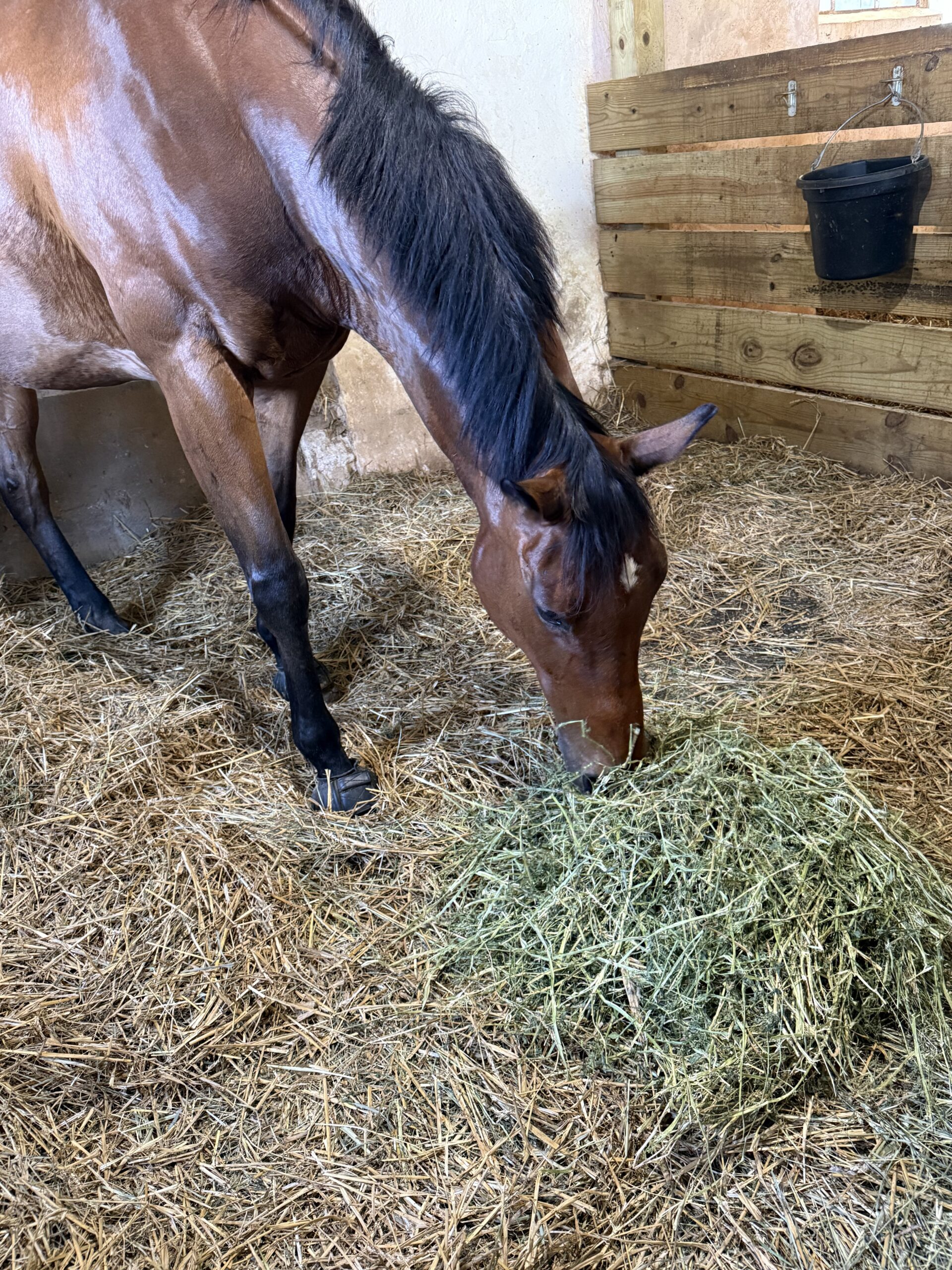
Whenever possible, forage should make up most of the horse’s diet to support a healthy hindgut microbiome. Photo courtesy of Haylie Pfeffer
The transition from racehorse to second career brings major changes to a Thoroughbred’s routine and diet.
Those changes can affect the digestive tract—especially the hindgut—but because hindgut problems can look like other health concerns, they are not always easy to identify.
Understanding how the hindgut works, what can disrupt it and when to involve a veterinarian can help owners better support their retired racehorses through the transition from the track to beyond.
The Healthy Hindgut and Hindgut Dysfunction
To start, it’s best to understand the hindgut.
“The hindgut of the horse is vital for their physiology and their health,” says Teresa Burns, DVM, PhD, Dipl. ACVIM, associate professor at The Ohio State University College of Veterinary Medicine, in Columbus. “They’re hindgut fermenters, so we see a lot of disease related to the hindgut in horses.”
The hindgut includes everything past the small intestine (the cecum, the large and small colon and the rectum), says Amanda C. Trimble, BVMS, MS, MScVetEd, Dipl. ACVIM (LAIM), clinical assistant professor of equine internal medicine at Texas A&M School of Veterinary Medicine, in College Station. “That takes up about 60% of the entire gastrointestinal tract.”
Numerous disorders can affect the hindgut. “Most people are familiar with hindgut conditions like colic (abdominal pain), including gas colic, displacements and impactions,” Trimble says. “Parasites can also affect the large colon, and stress can lead to dysbiosis, colitis or diarrhea. But what it basically comes down to is that the good gut bacteria are unable to do their job properly.”
Although infectious disease can cause hindgut dysfunction, veterinarians often attribute problems to noninfectious factors.
“Many causes of hindgut dysfunction may be related to diet, medication and ‘lifestyle’ issues in performance horses,” Burns says.
Diet commonly contributes to hindgut dysfunction in performance horses. Racehorses and other high-performance horses often receive feed with high levels of nonstructural carbohydrates (NSCs), which can lead to hindgut acidosis.
“When horses eat large grain concentrate meals, some of those carbohydrates may bypass digestion in the small intestine and reach the hindgut, where microbes ferment them,” says Burns. “If horses are being fed 5 to 7 pounds of high-sugar and -starch feed twice a day, there’s a lot of that nonstructural carbohydrate that likely makes it past the small intestine and reaches the hindgut. That can disrupt the hindgut microbiome, affect colon health and contribute to loose manure, low-grade colitis, absorption issues and other concerns.”
Non-steroidal anti-inflammatory drug (NSAID) use can also negatively affect the hindgut, especially in performance horses that might receive these medications for soreness or inflammation. Related damage can contribute to colitis, hindgut ulcers, diarrhea and persistent colic.
“It’s a common misconception that NSAID toxicity is caused by someone accidentally misdosing, which is very dangerous and certainly represents an emergency,” says Burns. “But most NSAID toxicity that we deal with can happen with chronic appropriate dosing. It takes four to eight months or longer for horses to recover from this.”
Physical and Behavioral Signs of Hindgut Dysfunction in Horses
Hindgut issues can be difficult to identify because the signs often overlap with gastric ulcers, training issues, discomfort and other health concerns.
“Common signs include recurrent low-grade colic, changes in manure quality, intermittent diarrhea, weight loss, loss of topline, poor performance, reduced enthusiasm for work and behavior changes such as irritability, stress, anxiety or lethargy,” says Trimble.
“Most of the time, hindgut disease is brought to someone’s attention because horses have mild intermittent colic,” adds Burns.
Some horses also show more subtle changes that owners might first interpret as behavioral or simply looking unhealthy overall.
“With any of these concerns, I encourage people to get on the phone right away with their vet, especially horses that are acutely colicky or horses that have a significant behavioral change in their day-to-day life,” Burns says.
Diagnosing and Treating Hindgut Issues
Diagnosing hindgut dysfunction often starts with collecting a thorough history, conducting a physical exam and testing to rule out other causes.
“A lot of what we deal with in the hindgut is really diagnosis of exclusion,” Trimble says. “We typically start with blood work, fecal testing for parasites or infectious causes and ultrasound to look for thickening or inflammation in the hindgut. We may also rule out things like gastric ulcers with a scope, then consider more advanced diagnostics depending on the horse’s history, presentation and clinical signs.”
“Many cases of hindgut dysfunction are rarely solved in a single veterinary visit,” adds Burns. “Owners should be prepared for a longer diagnostic process to fully understand what’s happening and develop the best plan to address it.”
Hindgut ulcers or inflammation can be trickier to address than gastric ulcers because they are more difficult to diagnose definitively and treat. For example, sucralfate might help coat ulcers in the mouth, esophagus and stomach, but very little of the medication likely reaches the hindgut in meaningful concentrations, says Burns. “It certainly isn’t going to hurt anything, but it probably isn’t going to be as effective there as it is in the stomach,” she explains. “Getting to the root of the problem is perhaps even more important for hindgut dysfunction.”
Horses receiving NSAIDs such as phenylbutazone (Bute), flunixin meglumine (Banamine) or firocoxib often have chronic lameness, back soreness or another source of discomfort. Prolonged NSAID use can contribute to hindgut dysfunction, including ulcers, adding another layer of complexity to their care.
“Most of the time, those horses are receiving those drugs for a reason,” Burns says. “They might have chronic lameness. They might have soreness, but now they’ve got this other issue with their hindgut that complicates things.”
Thoughtful diet, stress reduction and medication management can make hindgut dysfunction less likely.
“Those are probably the most important things people can do to minimize the risk of these kinds of diseases in horses, whether they are high-performance horses or whether they are retired and live in your backyard,” Burns says.
Whenever possible, forage should make up most of the horse’s diet to support a healthy hindgut microbiome. Trimble adds that reducing stress can benefit both gastric and hindgut health while supporting the entire GI tract.
How the Racetrack Transition Affects Thoroughbred Hindgut and Digestive Health
Supporting digestive health becomes especially important during a Thoroughbred racehorse’s transition period, when major changes in diet, workload, turnout, routine and medication use can all affect his stress level and hindgut microbiome.
“Any transition is going to be a bit stressful,” Trimble says. She recommends limiting NSAID use to situations in which a veterinarian advises it and focusing on ways to reduce stress. “Make sure they have a buddy, because isolation can add stress.”
As for feeding, Burns says these horses generally benefit from a gradual transition toward a forage-centered diet, with supplemental fat added if they need help maintaining condition.
“The slower the better with respect to dietary transitions,” Burns says. “The equine hindgut is relatively tolerant of taking things away from the diet, but it’s relatively intolerant of abruptly adding things.”
Prebiotics, probiotics—including the yeast Saccharomyces boulardii—and fermentable fibers such as psyllium could also help support digestive health during the transition.
Take-Home Message
“For horses that are prone to these hindgut syndromes, like racehorses in that letdown period after they come off the track, normalizing the hindgut microbiota and the fermentative capacity is the most important part of managing these problems,” says Burns.