
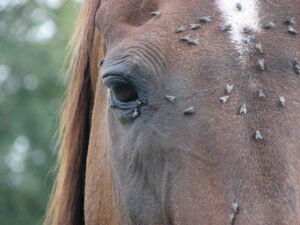
Photo credit: Jina Lee for Wikimedia Commons
However fast they are, Thoroughbreds remain vulnerable to fly-borne risks. While some are well-known, others, including a reemerging threat, continue to surface, making consistent, well-planned fly control essential for protecting horse health.
Fly-Transmitted Diseases
Flies can transmit diseases and infections by way of mechanical or biological transmission. Mechanical transmission occurs when an insect carries pathogens on its mouthparts, feet or body, transferring it to the horse by leaving it on the horse’s body or on objects or equipment the horse touches. Biological transmission occurs when pathogens replicate within the fly before it transmits them via bite to the next host.
Equine infectious anemia (EIA)
Also referred to as swamp fever, EIA is incurable and in its acute form highly fatal. “Stable flies and horse flies can be both mechanical and biological vectors of the causative agent of equine infectious anemia,” says Jonathan Cammack, PhD, Dipl. ABFE, assistant professor and state extension specialist for livestock entomology and parasitology at Oklahoma State University, in Stillwater.
Signs: fever, lethargy, anemia and reduced appetite
Equine Strangles
This highly contagious respiratory infection is caused by the bacterium Streptococcus equi subspecies equi (also referred to as S. equi), which can be spread by flies to healthy horses. Researchers (Pusterla, et al., 2019) detected S. equi in flies collected from a Thoroughbred farm during a strangles outbreak. “A total of 10/1,856 flies (0.54%) tested qPCR-positive for S. equi,” the authors wrote. “The results may implicate the presence of face flies as a risk factor for the transmission of S. equi and highlight the need to institute proper husbandry measures, biosecurity protocols and fly control in order to reduce the potential for infection in at-risk horses.”
Signs: lethargy, fever, thick nasal discharge, swollen or abscessing lymph nodes under the jaw
Pigeon Fever
This condition, caused by Corynebacterium pseudotuberculosis, results in abscesses, most often on the chest, where the resulting swelling resembles a pigeon’s breast. Houseflies, stable flies and horn flies can spread C. pseudotuberculosis. Veterinarians have seen an increased number of cases and, while horses most commonly develop signs in fall or early winter, seasonality of the condition follows biting insects.
Signs: external abscess in the pectoral region, abdomen, limb, flank or head
Eye parasites
“Face flies are known to transmit Thelazia nematodes (also known as eyeworms),” says Cammack. Eyeworms are common and can be found in the tear gland, tear ducts and sometimes in the third eyelid, as well as the cornea, conjunctival sac and under the eyelids.
Signs: irritation and inflammation of the eye, swelling, cloudiness of the cornea, ulcers
Summer sores
Also referred to as Florida sores, this painful and slow-healing, fleshy condition is caused by house flies, face flies and stable flies transferring parasitic nematode larvae (Habronema spp) into horse’s wounds or other openings such as their mouth, eyes or groin area.
Signs: nonhealing wounds, proud flesh (overgrowth of granulation tissue), itching
A Different Kind of Threat
Not all fly-related risks fit the same pattern. The New World screwworm, the larval stage of a species of blowfly (Cochliomyia hominivorax), is reemerging north through Central America and Mexico and could pose a serious threat to U.S. horses. Unlike flies that act primarily as irritants or vectors, its larvae invade living tissue through even small wounds.
Eradicated from the U.S. in 1982, the screwworm is now considered a potential reintroduction risk. “It’s a matter of not if, but when,” says Cammack, noting southern states bordering Mexico would face the earliest exposure. Signs include open wounds with maggots, pain and irritation, head shaking and a foul odor.
Protecting horses centers on vigilant wound care and prompt treatment, along with consistent fly control. Suspected cases must be reported to animal health officials, with confirmation based on testing of larvae. Treatment typically involves cleaning the wound, surgically removing larvae and administering appropriate prescribed medications; removed larvae must be destroyed as directed to prevent environmental spread.
Effective Fly Control Strategies: A Multimodal Approach
Environmental control
“Managing the sites where filth fly larvae develop are key,” Cammack says. Consider the environments you most often see flies: surrounding smelly trash, buzzing around manure-filled muck buckets, feeding sites consisting of dropped grain, silage and hay. Empty and scrub water and feed buckets regularly. Keeping these areas tidy will reduce the breeding sites and sources of food for flies.
Manure management
Muck stalls and remove manure and wet bedding daily at a minimum. “We compost and pull manure well away from the barn,” says Nelda Kettles, who alongside her husband, Larry, co-founded the Oklahoma-based Thoroughbred aftercare organization Horse and Hound Rescue Foundation. “Everyone’s starting their garden and often requests the composted manure to enrich their soil.”
Fly traps
Fly traps, when placed away from the barn, work well, and most can hold up to 40,000 flies. It’s not uncommon to see these in barn aisles, but it’s important to note this practice draws flies into the barn. Place them away from the structure and horses instead.
Premise and fly sprays
Quick knock-down is possible with chemical management such as barn fly spray systems, which proponents say successfully control and repel flies in the barn. Manufacturers offer an abundance of fly sprays; refer to the labels and apply accordingly.
When choosing sprays and application methods, consider the issue of resistance. “We’ve overwhelmed the fly population in the equine environment with synthetic pyrethroids, and we are seeing more resistance,” says Cammack. “That is why we want to think about managing the resources that they are attracted (manure, etc.) to help reduce how they are becoming established in the first place.”
Parasitic wasps
Kettles’ aftercare organization uses an integrated fly control system for control. It can be a balance, though. “I love Fly Predators [parasitic wasps that target fly pupae before they emerge as adults],” she says. “The only problem is we have a misting system, which will kill the fly predators before they can kill the flies. Between the two, I prefer Fly Predators because I prefer as few chemicals as possible.”
Fly gear
Fly protection gear, including fly masks, sheets and fly boots, can shield your horse when turned out. In selecting a sheet for your horse, keep these words of wisdom in mind from Cammack: “Houseflies are attracted to checkerboard patterns, and some other species of flies are attracted to more contrasted patterns.” In hot, humid climates be aware of how much the horse sweats underneath a fly sheet.
Fans
A nice breeze can deter flies from taking over the barn as circulating air makes flying conditions too turbulent for their liking. Be sure to utilize fans designed for outdoor use, clean them regularly and inspect them for damage since fans can be a fire hazard.
Take-Home Message
Flies can transmit disease as well as cause irritation. Consistent fly control and good management practices help reduce those risks.