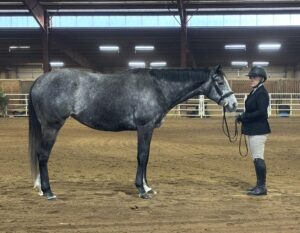
Dr. Craig Wood defines conformational balance as the proportional relationship of the forehand, middle and hindquarters. Photo Credit: Susan Kinmon
Like all breeds, Thoroughbreds come in many shapes and sizes. Some are long and lanky while others are compact and muscular. Even though these horses have a broad range of body types, people hold certain beliefs about them as a breed. Beyond temperament, they have a reputation for having long backs, being hard-keepers, having bad feet and being poor movers. These negative connotations can give Thoroughbreds a bad reputation as sport horses. But how much truth is there to these beliefs? Could people be overlooking a great horse simply because they won’t consider a Thoroughbred?
Using research, expert insight and practical training advice, let’s take a closer look at common misconceptions about Thoroughbred conformation and movement.
Evaluating the Thoroughbred Through Research
Thoroughbreds once dominated U.S. English sport horse disciplines but now rarely compete at the highest levels of dressage, hunters, equitation or jumpers. Eventing remains the notable exception, where they still compete at the top of the sport. Here the athleticism, bravery and endurance of the Thoroughbred help make their mark. As avid eventer and Thoroughbred proponent, Carleigh Fedorka, PhD, assistant professor at Colorado State University, in Fort Collins, put science behind that thought when she examined the influence of breed on performance at the CCI5*-L level of eventing (the highest level of competition recognized internationally).
She and her team did find one common belief about Thoroughbreds that held true through their results. “In our data, Thoroughbreds did accrue significantly more penalties than many of (their) Warmblood counterparts,” Fedorka says. “With that being said, we do not know if that is because of poor movement, rider influence or judging bias. We have to remember that the rider and the training on the horse have as much impact as the breed of the horse underneath them.”
Not surprisingly, analysis of the cross-country phase produced different results. “The Thoroughbred outperformed the Warmblood significantly in cross country, and that aspect of the overall competition is so impactful,” says Fedorka. They could not determine why that was the case because there were so many variables to assess, but she hopes to examine that in the future.
Conformation Traits in Thoroughbreds
Evaluating conformation starts with looking past broad breed assumptions. “Breed stereotypes are rooted in generalizations about an entire population, but movement evaluation must always focus on the individual horse,” says Craig Wood, PhD, assistant extension director for agriculture, natural resources and horticulture, and director of graduate studies for science, translation and outreach at the University of Kentucky, in Lexington, and a recently retired APHA judge.
Overall, the horse should be well-balanced and structurally correct. “Balance is the most critical conformational trait to consider because it influences the entire horse, from how easily it carries itself to how efficiently it moves,” says Wood. He defines conformational balance as the proportional relationship of the forehand, middle and hindquarters.
“It determines how effectively a horse can shift weight, stay coordinated and maintain efficient, athletic movement,” he adds.
Joyce Brinsfield, a trainer who specializes in Thoroughbreds and is based in Lawrenceburg, Kentucky, adds that she likes to see a horse with a long, sloping shoulder (about a 45-degree angle). This also helps make the horse a more comfortable ride.
As far as the common negative beliefs about Thoroughbreds mentioned, Brinsfield admits she still sees poor-quality feet (long toe/low heel or thin soles and hoof walls) regularly in Thoroughbreds as well as high withers and lack of topline, which can make saddle fitting difficult. A good farrier can help with the feet. Proper nutrition and conditioning can help build muscle over the horse’s topline. Importantly, she adds, how the horse moves can also be improved to an extent.
Assessing a Thoroughbred’s Movement
When assessing how a horse moves, the first question should be about how that horse’s movement aligns with his future performance discipline, says Wood. “Thoroughbreds are true athletes whose abilities extend well beyond the racetrack, and many go on to enjoy long, successful careers in a wide range of performance disciplines after retiring from racing.”
To properly evaluate movement, Wood says to observe the horse at the walk, trot and canter, ideally on straight lines and large circles. The horse should have a natural rhythm and consistent cadence at each gait and a soft footfall. “Stride length also matters,” he adds. “A longer, more efficient stride generally translates to a smoother ride with a horse that hits the ground softer and is more comfortable to ride.”
“A quality moving horse should use its back, lifting through the topline rather than traveling stiffly or hollow,” says Wood. “At the walk and trot, the hind feet should step into or slightly beyond the front hoofprints, indicating effective engagement and balance.”
That being said, Thoroughbreds currently at the track or recently retired might have tight backs and not show a long stride. Proper balance and conformation could indicate the type of movement they might have once relaxed and traveling correctly.
He also advises evaluating movement from multiple angles. “Viewing the horse from the side allows assessment of stride length, suspension and use of the back, while observing from the front and behind helps reveal limb alignment and straightness,” he explains. Structural deviations potentially could influence performance, longevity or soundness.
Improving Movement Through Training
Regardless of whether a Thoroughbred raced or not, good training methods focused on relaxation and the correct building of muscle over the topline can improve how the horse travels.
Brinsfield says she believes strongly that the horse must be appropriate for what the owner wants to do. “Too many people try to make the horse fit into the sport they want it to be in,” she notes. “It just may not be suited for that.”
She also says it’s important to first get the horse checked out by a veterinarian to make sure there aren’t physical issues that need to be addressed. Barring that she starts with working them on the longe. Then once she starts riding the horse she likes to do a lot of transitions, circles and poles on the ground. She adds lengthening and shortening the stride when the horse can balance well. “Then if they’re quiet enough and brave enough, you can take them out and trot up and down hills to help build their form,” she says.
When it comes to the show arena, “first and foremost, enjoy your Thoroughbred,” says Wood. “While competition can be rewarding, success should not be measured solely by how you finish in a class.” Instead he advises focusing on helping your horse perform to the best of his ability. “Concentrate on the factors you can control: the time you invest in your horse, the consistency of your training program and the patience you bring to the process.”
Final Thoughts for Thoroughbred Enthusiasts
Stereotypes of Thoroughbreds oversimplify a diverse breed. If you love Thoroughbreds and want one as your preferred partner, don’t let some negative perceptions deter you. Instead, heed advice from other devotees of the Thoroughbred.
Brinsfield, who had ridden a wide variety of breeds throughout her career, keeps coming back to Thoroughbreds because she’s comfortable on them. “Once they trust you, they’re such a better horse,” she says. She touts their athleticism but warns that as a rider you must be able to embrace and go with the power they have.
Similarly, Fedorka competes in eventing only on Thoroughbreds. “I paid my way through graduate school by retraining and selling OTTBs, so I am incredibly passionate about the breed,” she says.
Wood emphasizes that Thoroughbreds are exceptionally trainable, mentally adaptable and people‑oriented horses. “All horses are naturally sensitive and responsive; traits that are rooted in their evolutionary history,” he explains. “Too often, that sensitivity is misunderstood as poor temperament, when it is more accurately a reflection of awareness and athletic responsiveness.”
It’s up to owners to take the time to develop the skills necessary to match their Thoroughbred’s athleticism. Then they can enjoy their Thoroughbred partner for years to come.