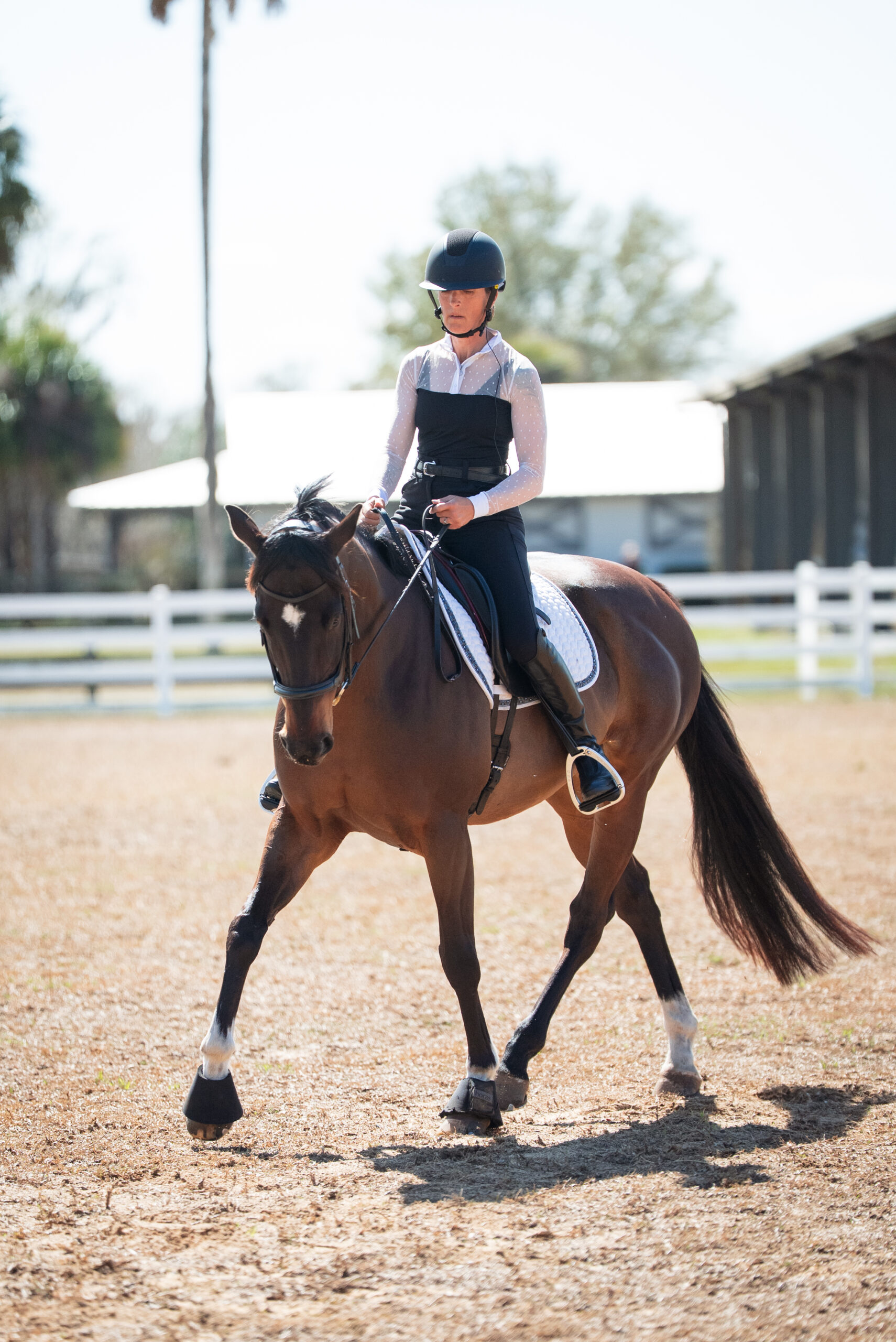
Chelsea Canedy says the rider’s job is to help the horse discover a healthier way of using his body. PC: Haley Booth-Zajac, Impulsion Media
An athletic Thoroughbred finishing his racing career typically has a lean, muscular physique. However, following retirement and being let down, he can lose muscle quickly. As horses transitions to a new career, owners often ask how to rebuild the strength and conditioning needed for the next job. How can you correctly build muscle over the back and hindquarters so horses can carry themselves well, improve overall balance and stay sound? It can be a challenge, but with time, patience and the correct training program, horses can develop the strength needed to take on most disciplines.
Thoroughbreds Straight Off the Track
A starting point is to understand the key muscles supporting the skeletal structures and how to develop them. Allan Davie, PhD, adjunct associate professor at Southern Cross University, in New South Wales, Australia, lists the longissimus dorsi, iliocostalis and psoas as the key back-supporting muscles. Why are these muscles so important to the horse? “Because they support the horse’s back structure, allowing the animal to carry weight, jump and perform athletic movements,” he says, along with allowing extension and flexion of the spine.
The abdominal muscles, including the obliques and transverse muscles, also help support the back. As opposing flexors of the back, they help the horse round his topline and lift his core.
Chelsea Canedy, horsemanship expert, dressage and event rider at Unexpected Farm, in Wales, Maine, has seen the benefit of addressing the core. “As a horse strengthens its abdominal muscles, the topline can function more effectively,” she says. “The back, loins, glutes and hamstrings work together with the core to stabilize the spine and pelvis. That stability allows the horse to generate power through the center of the body and transfer it efficiently to the limbs.”
Canedy further explains that trainers and riders often overlook topline development because they assume it will happen naturally through regular work. “But muscles strengthen according to how they are used,” she says. “If a horse repeatedly travels with a hollow back, a braced neck or an overdeveloped under-neck, those are the patterns—and muscles—it will continue to reinforce. Simply exercising a horse is not enough; the quality and posture of the movement determine whether the horse develops the muscles needed to carry itself and a rider safely and effectively.”
Muscle Weaknesses in Thoroughbreds
Even fit, athletic Thoroughbreds can develop back issues related to how they were ridden and trained during their racing careers, says Davie. “A proportion of back issues can be generated as a result of the rider’s balance, in which the weight is not balanced over the horse correctly,” he explains.
In addition, he points out hamstring soreness can result from the quantity of gallop work and if this involves lots of hill gallops (more common in Australia and Europe than in the Unisted States). “This soreness or tightness in the hamstrings can be managed by incorporating lots of extended trotting work (to encourage horses to stretch out) into the program to help balance out the hamstring development and tightness,” he adds.
Thoroughbreds given time to relax, decompress and acclimate to life off the track might not have these issues. Regardless, a Thoroughbred’s physical condition is only part of the picture when preparing him for a new career.
The Thoroughbred’s Mental State to Begin Training
Canedy says she believes the strongest results come not from strong physical training, but from clarity, regulation and true partnership. Therefore, before approaching the physical exercise component, she approaches the mental side.
“Emotional balance is not separate from physical development,” Canedy says. “It is the foundation for it. A horse that feels anxious, rushed, confused or defensive will naturally brace its jaw, neck, back and abdominal muscles. In that state, even well-designed exercises can reinforce tension and compensation rather than build healthy, functional strength.”
She points out the importance of the horse understanding the request, maintaining a steady rhythm and responding without excessive tension before adding hills, poles, transitions or other strengthening work. “From there, strengthening becomes a process of teaching the horse to use the correct muscles and then reinforcing that movement through calm, consistent repetition,” she adds.
Exercises to Build Topline and Hindquarter Muscles
“Two of my favorite exercises are walking up and down hills and working over raised walk and trot poles,” says Canedy. “Hill work asks a horse not only to push, but also to balance. When introduced gradually and performed in a balanced posture, hill work can strengthen the hindquarters, core and stabilizing muscles throughout the body.”
She says raised poles have a similar effect. The legs lifting higher than usual increases their range of motion. “Pole work also encourages many horses to look down and forward as they assess what is beneath their feet,” she adds. “This can help them lengthen through the neck and back, provided they remain relaxed and are not rushing through the exercise.”
Davie agrees that adding these exercises can be very helpful especially in horses not using their hind limbs properly to push. He also supports the use of treadmills, because a trainer can control the work intensity by increasing the grade. For older horses the treadmill adds a safe exercise mode that reduces stress on the joints.
The Importance of Transitions
Transitions within and between different gaits, like pole work, offer strengthening benefits, but their effectiveness depends on the quality of the movement.
“A balanced transition asks the horse to stabilize its body, shift weight and organize the hindquarters,” says Canedy. “A rushed or hollow transition (or the same posture over poles) may simply reinforce tension and poor movement patterns.”
She goes on to explain how correct work often feels more difficult to the rider because it requires more muscular effort from the horse. “Horses naturally tend to choose the movement that feels easiest and conserves the most energy,” she says. “They have no reason to perform a transition in a more physically demanding posture unless we patiently teach them how. Our job is to help them discover a healthier way of using their bodies, then strengthen that pattern through calm, correct repetition.”
Engagement of the Horse’s Hindquarters
Canedy says owners often mistake speed for engagement. “A horse that is truly moving forward with balance produces purposeful, elastic strides without rushing,” she says. “The hind legs step actively beneath the body, the back begins to lift and swing and the energy travels through the horse rather than spilling out through speed.”
Visually, movement patterns are probably your best guide, says Davie. Watch the horse for tracking up or overtracking, meaning the hind feet land in or beyond the hoofprints of the front feet.
Still, Canedy notes that tracking up by itself does not guarantee engagement. Conformation, speed and stride length can all influence where the feet land. Also, as muscles develop, the horse begins to look fuller and rounder through the hindquarters, loins and back. Under saddle work might appear more controlled and balanced and require less visible effort.
Ideas for Typical Training Sessions
Canedy describes ideas for typical 20- to 30-minute training sessions, keeping in mind quality always comes before quantity.
- A short session might begin with several minutes of relaxed, purposeful walking to allow the horse to loosen his body and settle mentally.
- Focus on one strengthening goal. For example, the session might include a series of well-prepared transitions between halt and walk and/or between walk and trot. The priority would not be reaching a particular number, but producing calm, balanced transitions and allowing the horse to rest whenever the quality begins to decline.
- A session could focus on raised walk poles, with several thoughtful passes in each direction. The horse should have time between passes to relax, reorganize and avoid fatigue.
- Spend the time walking up and down gentle hills.
- Try any of these exercises from the ground instead of squeezing in a rushed ride.
“The goal is not to fit every gait and exercise into every session,” she says. “It is to choose one or two objectives and repeat correct movement while the horse is still relaxed and capable. Whether I have 20 minutes or an hour, I keep returning to the same principle: quality over quantity.”
Davie also says rest and recovery days should balance the intensity and duration of training sessions to help prevent fatigue and overtraining. He adds that balanced nutrition is equally important. Amino acids support muscle growth, and energy intake should match the horse’s workload.
Take-Home Message
Many people love Thoroughbreds for their athleticism. With enough time and careful training, they can develop their back, core and hindquarters to carry them through most any discipline for many years.