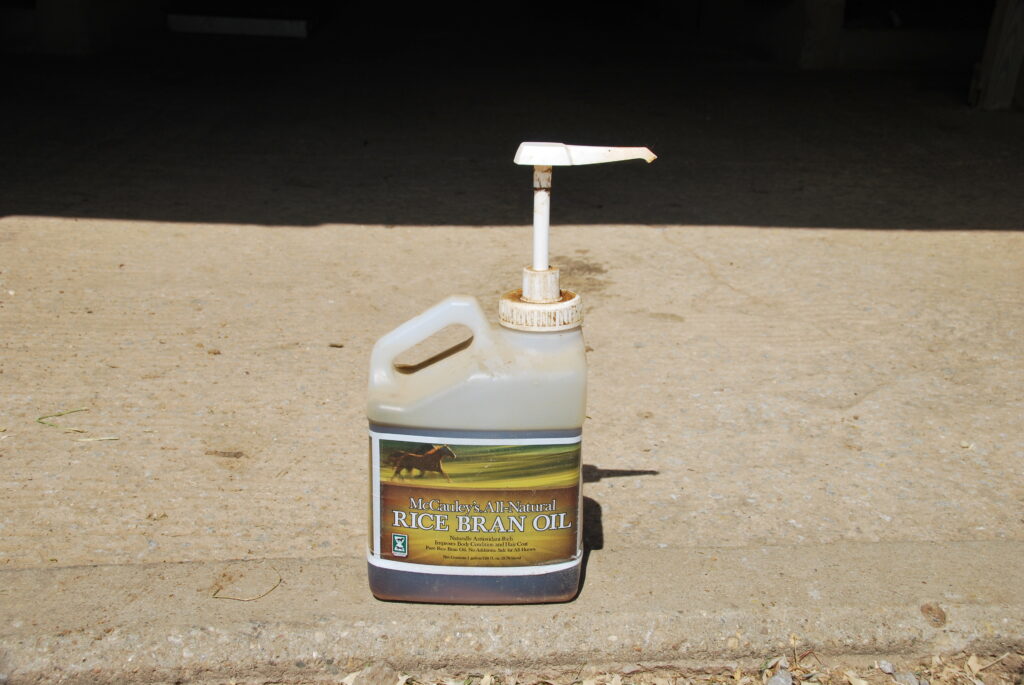
Owners can add several different fat sources to a horse’s ration. The most common sources are plant-based oils, including rice bran oil. Photo by Alexandra Beckstett/The Horse
A glug of oil here, a jigger of oil there, and a couple of pumps of oil everywhere. Owners have been adding fat to horses’ feed for various reasons for many years.
Amy Parker, MS, PAS, equine nutritionist and technical services specialist at McCauley’s Feeds, in Versailles, Kentucky, defines fat as a concentrated form of calories easily digested by the horse. Fat provides 2.25 times more calories than an equal weight of carbohydrates, making it easier to add calories without increasing bulk in the ration. Even though horses do not have a nutritional requirement for fat, adding fat to the diet can benefit many Thoroughbreds that:
- Struggle to gain or maintain weight. This can include aged or senior Thoroughbreds showing physiological signs of aging, including dental disease or tooth loss, which makes chewing ineffective and leads to a loss of body condition or body fat.
- Have a high energy demand. This can include Thoroughbreds working in performance activities such as eventing, barrel racing, endurance/competitive trail riding and show jumping, as well as broodmares in heavy lactation or late gestation. Parker adds that researchers have shown fat added to performance horse diets might confer metabolic advantages that could improve stamina and prevent overheating during work in the hotter months. In addition, researchers have also reported reduced stress and startle reactions in horses consuming a high-fat diet (10% fat).
- Deal with metabolic issues such as pituitary pars intermedia dysfunction (PPID, formally known as equine Cushing’s disease), equine metabolic syndrome (EMS), insulin dysregulation (ID) or have a history of laminitis.
- Could benefit from improved coat and skin condition.
Because horses have a limit to the amount of feed that they can consume each day, Jennifer Moore, PhD, assistant professor of equine studies at Midway University, in Kentucky, says feeding fat allows owners to add calories while preserving most of the horse’s physical eating capacity for forage. Historically, the option for adding calories was starch-rich grains, but excessive amounts of these feeds carry an increased risk for reactive or stereotypic behaviors (those without any apparent purpose — think weaving, stall walking, etc.), gastric ulcers, hindgut acidosis, colic and, in severe cases, laminitis from carbohydrate overload.
Sources of Dietary Fat for Horses
The pasture, hay and grain a horse consumes provides only a small amount (2-5%) of naturally occurring fat. Researchers have shown horses can digest and effectively utilize up to 20% of the total diet (by weight) as oil, absorbing nearly 100% of the fatty acids from oils and other fat feed ingredients in the small intestine. Most commercial high-fat feeds contain 6–14% fat.
Owners can add several different fat sources to a horse’s ration. The most common sources are plant-based oils, which include:
- Corn
- Soybean
- Canola
- Flaxseed (linseed)
- Coconut
- Camelina
- Rice bran
- Wheat germ
- Sunflower seed
- Ahiflower
- Olive
- Store-bought vegetable (soybean oil most common as a single source or a blend, usually of soybean and corn oils)
Horses can also digest and utilize marine-based oils, fat-rich ingredients and animal fat.
Marine-based oils include:
- Fish (from a single source or a blend of salmon, menhaden or cod)
- Palatability and smell issues can limit its use
- Algae
- Cod liver
Fat-rich ingredients include:
- Rice bran
- Flaxseed
- Whole soybeans (heat-treated)
- Chia seeds
- Black oil sunflower seeds (BOSS)
Animal fats include:
- Beef tallow (clarified animal fat)
In reference to animal fat use, Parker reminds us horses are herbivores, not carnivores or omnivores. Although horses can utilize beef tallow blended with vegetable oil, she cautions against using it because of potential animal-based disease risks.
How to Add Fat to Your Horse’s Diet
Top-dress current feed
Parker says deciding when fat is appropriate and how much to add to your Thoroughbred’s diet ultimately depends on your goals. If your goal is to improve coat quality, shine and skin condition, then adding approximately 2 ounces per day (or 60 cc per day) of oil should provide those results. The easiest approach with a small amount is to top-dress your horse’s existing feed.
Oils are 100% fat, says Parker, meaning they contain no protein, vitamins or minerals. If you top-dress more than 1 cup of oil per day, then you’ll need to evaluate the dietary intake of protein, vitamins and minerals to ensure it still meets the horse’s daily requirements.
For putting weight on a thin horse or supplementing calories for a performance horse, “adding fat to the diet should be done gradually,” says Moore. A good starting point for most horses is around ¼ cup (2 ounces) of oil per day. The amount can increase over a period of about 2–3 weeks. The goal for weight gain or work should be 4–8 ounces (½–1 cup) of oil per day, adds Parker. Both sources caution that higher levels or increasing the fat amount too quickly can lead to loose, oily stools. In addition, high fat levels can also inhibit absorption of other nutrients, so consult with an equine nutritionist to make sure your horse’s overall diet stays balanced.
Add fat-rich ingredients to existing feed
Fat-rich ingredients are lower in fat (25–40% fat) than oil (again, 100% fat). Moore says they are often more shelf-stable, can be more palatable and certain forms might be helpful for horses that try to sort around top-dressed oil.
However, the downside of adding a fat-rich ingredient is you have to feed a greater quantity to get the same benefits from simply adding oil, says Parker. In addition, she explains, if you choose to add rice bran or flaxseed to your horse’s diet, you must balance the diet’s calcium and phosphorus. Rice bran is inherently high in phosphorus; adding a significant amount of rice bran to the diet inverts the calcium:phosphorus ratio. She suggests utilizing a stabilized rice bran with deactivated lipase enzyme, which reduces potential rancidity and provides a long shelf life. Such a product also could be fortified with calcium, so Parker says to read the label carefully.
When adding fat-rich ingredients to your horse’s feed, again introduce them slowly. Depending upon the feed ingredient and goal, Parker suggests mixing in 1 ounce per day and increasing the amount by an ounce every other day over a two- to three-week period, feeding up to 1 pound of the oilseed ingredients per day for desired weight gain. If using rice bran, mix in ¼ to ½ pound every other day, increasing to 1 to 3 pounds of rice bran per day while monitoring the horse’s weight gain.
Feed high-fat commercial feed or commercial fat supplements
“A formulated high-fat feed is typically nutritionally balanced when fed according to feeding guidelines; it is usually more shelf stable and often more palatable,” says Moore. The feeds’ fat content increases with the addition of oil (usually soybean or corn), flaxseed and/or rice bran. Many high-fat commercial feeds do not contain cereal grains, making them a better fit for OTTBs with metabolic conditions or those needing an alternative calorie source.
Commercial fat supplements are usually 25–40% fat and formulated to be added to an existing ration. They could be a blended mixture of fat-rich ingredients and/or oils to include rice bran, flaxseed, heat-treated soybeans and plant-based oils. They are usually fortified with protein, vitamins and minerals and could be advantageous when large amounts of fat are needed in the diet.
Quick points on omega-3 and omega-6 fatty acids
The effects of omega-3 and omega-6 fatty acids on inflammation and whether the type of fat fed can provide any health benefits remain hot topics.
In brief, omega-3 and omega-6 are two different families of fatty acids. Moore says omega-3 fats tend to form signaling molecules with anti-inflammatory effects, while omega-6 fats tend to form signaling molecules with pro-inflammatory effects. The balance of the fatty acids dictates the overall response.
The horse’s natural diet of fresh forage contains many more omega-3 (anti-inflammatory) than omega-6 (pro-inflammatory) fats. Of the oils supplemented in the horse’s diet, corn, soybean and rice bran are higher in omega-6 fats, while flaxseed and fish are higher in omega-3s. With limited research on omega-3 supplementation in horses, Parker stresses the need for further research before appropriate recommendations can be made.
Final Thoughts
Fat packs a big punch as a safe alternative calorie source for your horse. Adding fat to the diet can help support weight gain in horses in poor body condition, meet the needs of those in high-calorie-demanding work, provide calories without added sugar and starch from grains or simply support skin and coat health. Work with an equine nutritionist or veterinarian to determine if fat supplementation fits your horse’s needs, choose your fat source wisely, and give your horse time to adapt to it.