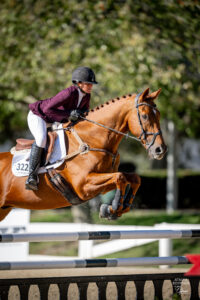
Photo by Atalya Boytner for Erin Gilmore Photography
Q: How do you settle a horse with a “busy mouth” under saddle – a horse that chews or fusses with the bit?
A: I often find when horses have “busy mouths” it’s often a secondary behavior. So I typically ignore the mouth and focus on what’s causing tension for the horse: we go back to focusing on the basics of rhythm and relaxation. As horses start to accept the contact and soften in their backs, often the mouth quiets down on its own.
If these issues don’t improve with training, it’s also a good idea to check the teeth and mouth to make sure there aren’t any issues that need to be addressed. I also find chiropractic work to be a good idea in these cases. In general, a vet can rule out physical issues that might be presenting as training problems.
In general, I look at the busy mouth as a sign of a horse that needs something else to focus on in training. I encourage a lot of long and low stretching, and then ride the horse to find its rhythm based on my seat – teaching the horse to speed up or slow down with the rhythm of my post is a good basic, as well as slowing down when I squeeze my thigh.
In my experience, some horses are just more of a worrier type, and they might be busier with their mouths at the beginning. I worked with a horse named Claus who was a great example of this type: he was never “bad” or pulled any naughty moves, but he was just extremely body-tight and high energy with a busy mouth and would sometimes even put his tongue over the bit.
For horses like this, you might need to look at your tack selection. Some riders might have fixed this by adding a flash, which restricts the ability of the horse to open the jaw enough to get his tongue over the bit. Instead, I left him in a very loose noseband and switched him to a leather bit: it’s a soft and natural bit that I find can encourage a horse to accept the contact as it molds to the individual horse’s mouth. This can be a good bit for very mouth-sensitive horses.
Ultimately, I ended up going back to ground work with Claus: we did a lot of simple in-hand work in transitions, whoas, and changing of direction all in a rope halter. These simple exercises got his mind engaged on me and not his stablemates or other distractions. These transitions, both between and within the gaits, and changes of direction help get the horse engaged with the handler and mentally present, which then leads to relaxation. The body relaxes through the back, which extends to the mouth.
In some cases, I may also use some additional tools, such as side reins or a neck stretcher, and only after the horse is educated on how to lunge first. I use these tools applied very loosely, and spend the majority of the time in the walk and trot on the lunge with attention to transitions. The concept on the lunge is the same as both ground work and under saddle – the transitions are intended to engage the horse’s mind on you until they’re relaxed through the body. This process in particular can be fascinating to watch for a busy mouthed horse when you witness the moment the brain engages, the body relaxes, and the mouth goes quiet!
When it’s time to work under saddle again with these kinds of horses, I focus on the basic response of how the horse yields to pressure. The end goal is for the horse to yield to contact: I’m seeking for the horse to lower the head and neck, which I meet with a release of pressure in the contact. If you’re just starting out with a new green horse, this might be a great time to work with an experienced trainer to help you achieve this foundational skill successfully.
In summary, a busy mouth is typically a horse that needs mental stimulation for any variety of reasons – and don’t forget the importance of ruling out physical pain. Weakness or a lack of development, however, can be addressed through all of the exercises outlined above, building relaxation as well as top line that can eliminate little problems like busy mouths without worry about the mouth itself.
Kristina began her professional career focusing on eventing and jumpers, training under some of the top professionals in the country. She briefly stepped away from riding to pursue her calling as a missionary, before returning home with a renewed purpose. Now, she dedicates her talent to retraining off-the-track Thoroughbreds for successful second careers. Kristina is the owner and operator of Reciprocity Thoroughbreds, based in Decatur, Texas.