Social media, as well as the RRP Horse Listings, have enabled potential Thoroughbred owners to review a large number of retiring racehorse listings at any time. Newcomers to the breed might find it challenging to consider a prospect right off the track and decide if it’s a match for their desired purpose.
In this column, veteran Thoroughbred Makeover trainers share their strategies for assessing and selecting prospects, and assess provided conformation photos based on their discipline of choice. We feature trainers from two disciplines in each column.
Our Trainers
Kara Lee
Winner of 2025 Field Hunter with Street Ready
Kara Lee came to horses a little later than most, adopting her first horse (a Thoroughbred) while in college. That experience set the stage for her following years as a horsewoman, including a decade as an exercise rider on the track. To date, she still lends a hand to racing barns when she can. She’s also ridden a wide range of disciplines, from fox hunting and eventing to barrel racing and roping, seeing the value in learning from each sport in order to be a better-rounded horseman.
Marty Riney
Winner of 2025 Dressage with Patou Road
Marty Riney caught the horse bug early, always wanting to ride her grandfather’s cow pony as a toddler. That led to riding lessons starting at three years of age where one of her favorite school “ponies” was a large, kind Thoroughbred named RB. She went through USPC achieving her A rating and did Young Rider’s Championships at the CCI** level on a thoroughbred named Final Score. She has brought along many Thoroughbreds and retrained them in eventing and dressage. She currently is competing at Preliminary level in eventing on the Ryan family’s Hunter O’Riley. Marty is a veterinarian who has a dental specific practice MWR Equine Dentistry and greatly enjoys caring for so many Thoroughbreds in multiple disciplines.
Choosing a Horse
Each of our trainers has their own unique approach for selecting Thoroughbreds. Lee has built relationships over time with a trusted handful of trainers, allowing her to source her horses directly from the track. “While I’d love to retrain every horse myself, I truly enjoy matching them with the right homes where they can thrive in their next chapter,” shares Lee. “When time and resources allow, I try to keep one project horse for the Makeover.” Lee rehomed around 30 horses in 2025, and over the years has built lasting relationships with many repeat buyers.
Riney, by contrast, is typically sourcing horses for herself, and likes to meet horses in person before she makes her decision. “My hours to ride are precious,” she describes. “I want to make sure I am picking a horse that I can spend my time with and enjoy them.”
She looks at expression, overall balance, and history when making her choices, and includes movement when analyzing prospects. “Horses that are aware of body parts and can move to pressure with ease typically make better sport horses,” she adds. She considers the horse’s history, including their behavior on the track, as well: “I have young children and boarders around, so I need a horse who is a good citizen. This history usually gives me a good handle on if they will handle the fun chaos they will be coming home to!”
Lee adds that she has a particular soft spot for a war horse: “There’s something special about a horse that stays mentally and physically sound through that many races.”
Meet the Prospects
Our model horses all come from New Vocations Racehorse Adoption Program, which has nine facilities and in six states. Racing connections donate horses to New Vocations at the end of the horses’ racing careers, either directly or through programs such as NYTHA’s Take the Lead or Beyond the Wire. Connections complete and submit a horse application form and send all available veterinary records and information for New Vocations to determine if the horse is a good fit for its program.
New Vocations prides itself on its ability to provide long- and short-term veterinarian-supervised rehabilitation services for horses after injury or surgery and before they begin their retraining. This process includes veterinary evaluation at the time of donation for horses with less robust veterinary histories or those with clinical signs not noted in histories, as well as continued rechecks throughout the veterinarian-prescribed rehab protocol. Once horses return to soundness, they start basic transitional training when mentally and physically ready.
New Vocations relies on donations, fundraisers, grants and other financial gifts to carry out its mission to rehab, retrain and rehome retiring racehorses.
While these horses might no longer be available for adoption when this article publishes, New Vocations has plenty of prospects available for adoption at newvocations.org.
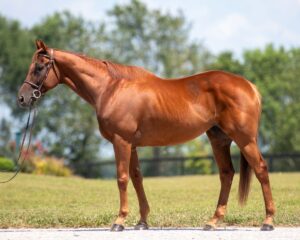
Horse 1: Dusty Boy (Giant Fun – Magical Mia, by Gold Fever)
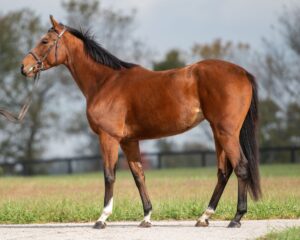
Horse 2: Need More Cowbell (Mckinzie – Bonny Bell, by Super Save)
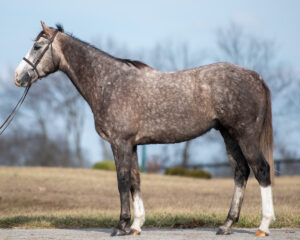
Horse 3: Champagne Justice (Justify – Champagne Royale, by French Deputy)
Lee’s Picks:
Horse 2: This horse is my first pick. Even though the photo is taken slightly from behind, she appears to be very balanced and proportionate. She has a nice, sloping shoulder, and her neck ties in fairly uphill, which suggests she would naturally elevate her front end over fences. I’m a big fan of a compact horse with a shorter back, as I feel they have a better chance of staying sound and offer a more adjustable stride. While I think she could succeed in a variety of disciplines, I would especially enjoy taking her over fences — whether in show jumping or eventing.
Horse 3: This horse is my second pick. I love how stout and thick he is — he appears to have a powerful hind end and is well balanced overall. His shoulder is fairly straight, which makes me envision him excelling in western tack, whether in trail or as a ranch horse. I also like his shorter pasterns, which should lend themselves well to the stopping and cutting required in many western disciplines.
Horse 1: This horse is my third pick. He is beautifully turned out, and his coat shines like a copper penny. His neck is slightly shorter than I typically prefer, but he has a lovely shoulder. It may be the way he’s standing in the photo, but his hind end doesn’t appear as powerful as the other two. Overall, I could see him being light on his feet and quite agile, making him a versatile prospect for whatever discipline his rider chooses.
Riney’s Picks:
Horse 1: This is my first choice: that keen and kind face draws me in immediately. But when looking at his body I love the way his neck goes into his withers — I find it much easier to ride this type of horse into a soft and round topline. He has even thirds in his body, allowing engagement of his hind end easier so he can learn to lift his topline and hold himself in better collection over time. He also appears to have a strong hindquarter which will allow for power. He appears to have decent feet that fit the size of his body and he has enough bone without being heavy. Overall he looks like an athlete who could go in any direction.
Horse 3: This is my second choice: this looks like a horse of substance and balance. This horse has a shorter back with a strong hindquarters which makes tracking up and getting his hind end under himself an easy time. His neck is set a bit lower into his wither with a more developed under side of his neck- that can be changed with proper riding and time. He is a bit more straight in his shoulder than horse #1 as well but nothing that I would expect would make him a choppy mover. I love his kind face and he has a great sized heart girth. I think this horse would make a very lovely sport horse as well but may take a bit more time to train his body to go in a rounder frame.
Horse 2: All of these are quality horses but for me neck positioning is a big preference and this one appears to have the most developed underneck and likely lowest placement of neck into withers. I find all horses can learn to lift and hold their toplines but this will take longer than the other two. It appears the hindquarters are also a bit higher than the withers which will send him a bit more downhill naturally. Haven ridden many horses like this, it just takes a bit more time to teach them how to sit on their hindlegs. I love the bright face and smart appearance. The hindquarters are strong in appearance which can lead to power over fences. He will make a lovely well-rounded type in the long run.