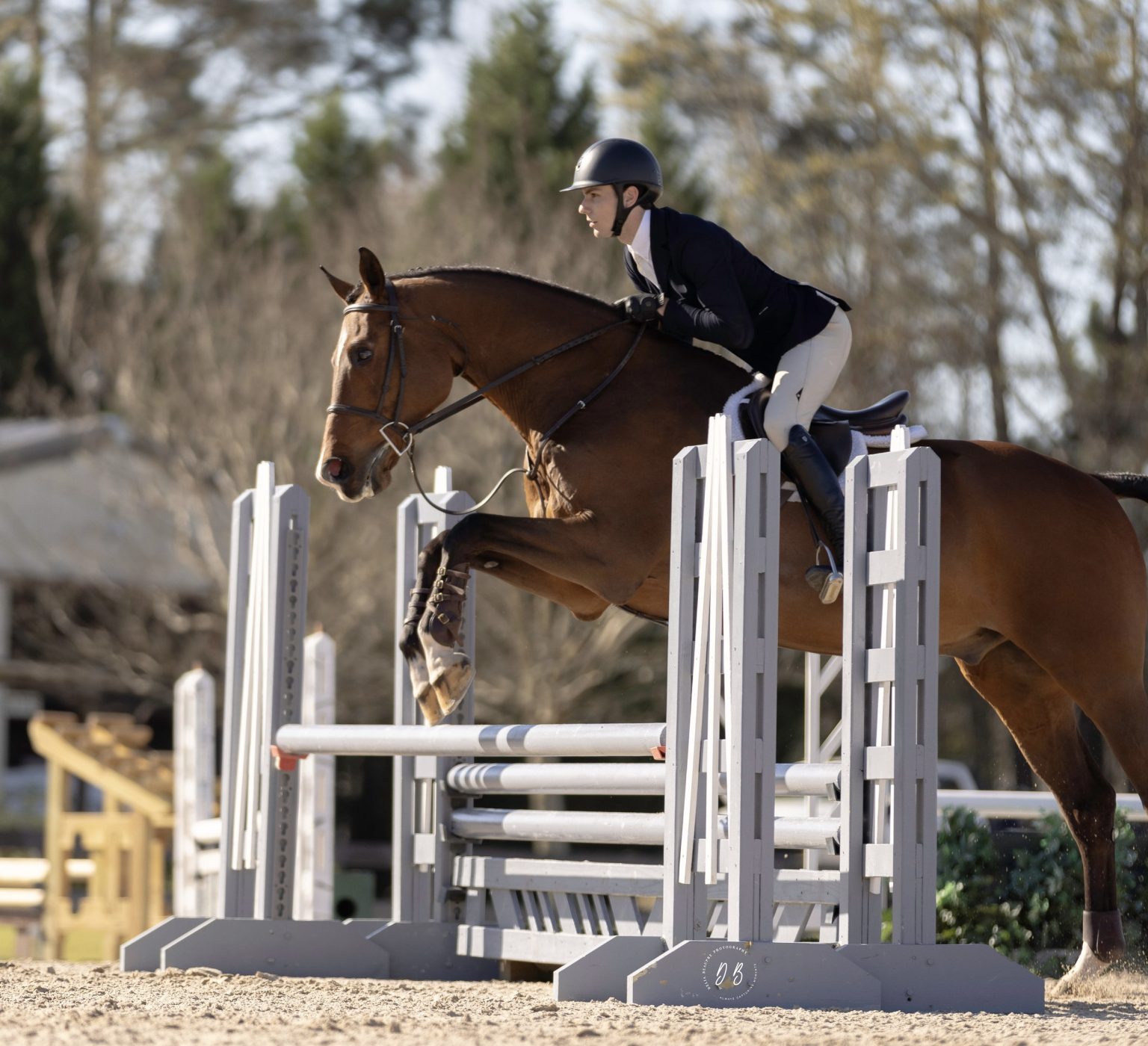
Photo courtesy The Plaid Horse
This article is reprinted in partnership with The Plaid Horse, and is part of the publication’s ongoing Trainer Tuesday column. Access the original column here.
Welcome to Trainer Tuesday! Each week The Plaid Horse asks trainers a question and gathers their answers for you. These trainers have a range of experience, backgrounds, and focus points of their programs, so the answers have as much variation as you would expect and also probably much more similarity.
This week’s question posed is: When a rider realizes they are asking for an incorrect distance or none at all, what should they do?
Here are their answers:
“This frequently occurs because it takes time and practice to recognize when a good jump is going to happen. More often than not, the bad distance happens because of a bad rhythm or a bad track, but once you realize this, it is often too late.
By that time, the most important thing to do is NOTHING. Stay out of the horse’s way. That means your heels stay down and your eyes stay up (assuming that’s where they started!). You must keep a soft hip angle so you can move with the horse, stay in the middle, and have a forgiving arm so that the horse doesn’t feel a punishment in the bridle.
Hopefully, you are in a position where you or your horse doesn’t lose confidence and maybe go back to practice again. We should be forever grateful for the kind horses we get to ride.” –Gisele Beardsley O’Grady
“I tell my students when they don’t know what to do at a bad distance or the jump hasn’t come up well they must trust the horse and their ability to recover the situation. We practice a lot of small jumps out of rhythm and don’t focus as much on distance when the riders are young or learning which can help them feel when the jump isn’t quite right; it also teaches the horses they can leave the ground from anywhere and it won’t be punished by a rider that’s picking or kicking.
In the instance that a jump comes up and the rider isn’t sure what to do, they know to allow the neck by giving rein, stay still with their body, offer support from their calf so the horses know it’s safe to leave the ground even if its not ideal, and to grab some mane in case the jump is jarring. This way, an awkward jump doesn’t become a scary one! Our horses’ scope and bravery will get them to the other side, and they can try again with some tools to find the jump a little better the next time.” –Brittany Massey
“1. Stay Calm and Soft
- Do not panic or suddenly grab the reins or clamp with your legs. Tension will confuse or unsettle the horse.
- Maintain a steady rhythm and keep your body balanced and neutral.
- Support, Don’t Overreact
- Provide leg support to encourage forward momentum, but don’t rush.
- Keep a soft, elastic contact with the reins—don’t pull or throw the reins away.
- Fix the Canter
- Focus on improving the quality of the canter rather than obsessing over the distance:
- Forward but not fast
- Balanced and rhythmical
- Straight
- Look Ahead and Ride Confidently
- Keep your eyes up and focused beyond the jump, not down at the spot.
- A confident, forward ride helps the horse feel secure, even if the takeoff spot isn’t ideal.
Don’t:
- Freeze or stop riding—this leaves the horse without guidance.
- Lean forward or back suddenly—this can unbalance you both.
- Pick at the reins trying to “find” a distance—this usually makes things worse.
Summary:
If the distance is wrong or unclear, ride forward with balance, rhythm, and soft support, and trust your horse as much as possible. Training and consistency will improve your eye for distances over time.” –Lindsay Lindke
“When you realize that you committed to an incorrect distance, keep supporting your horse with your leg and hold your body at the fence. Try to stay out of their way–most of the time, they can get you to the other side if you do so! After the jump, come back to your rhythmic balanced canter and proceed with confidence to your next fence! Do not let it rattle you.” –Kathryn Kraft
“Sit still and keep your leg on!” –Dana Hart-Callanan
”The problem of an “incorrect or no distance” often stems from a problem farther back than the immediate task at hand, which is the jump. This problem often arises and can relate to the track the rider has chosen to the jump, and to the quality of the canter the rider has, or lack thereof. I find that if the rider can really work towards a straight track, and good quality of canter with some adjustability in the step, this helps mitigate the problem of the uncertainty of a distance.
If a rider is feeling they are at the incorrect or at “no” distance, I find the best advice I can give to them is to breathe out, sit up as tall as possible, keep a connection between leg and hand, and support the distance that will eventually “show up” for them. A cluck at the fence to support their ride to step over the jump often helps the horses continue in the forward motion over the fence.” –Lynn Macyk
“Typically, by the time a rider realizes the distance is incorrect, they are too close to the fence to fix it without hindering the horse. The most helpful thing for a rider to do at that point is to stay balanced in the saddle, with a supportive leg and soft, following hand. This will give the horse the best chance at getting over the jump safely.
If a rider doesn’t look for a distance, I’d encourage them to start counting strides to the jump. It will help them keep a rhythm to the jump and slowly start to realize where they are in relation to the jump.” –Emily Szokol
“My go-to any time I don’t feel like I’m seeing a distance, and what I tell my students, is leg on into the contact to create a distance. The purpose of leg into contact is to change the horse’s balance, making it more uphill and increasing the engagement of the hind legs. Keeping your eye a little relaxed also helps the rider focus more on direction, speed, rhythm, connection, and straightness than whatever distance they may, or may not see, whether in a ring or out on cross-country.
Here’s what I tell riders to think about:
Leg on into the contact with elbows moving in the connection, so your horse can change their balance going forward.
Soften your eye by keeping them up and intentionally blinking.
Continue your canter rather than slowing down, pulling back, or stopping riding. You can practice getting better at this by going back to basics. Set two poles on the ground 74 feet apart. Canter the poles focusing on speed, direction, consistency of rhythm, straightness, and your horse’s balance. Practice four, five, and six strides between them. Do this until you’re able to meet them consistently at the right distance because you have the ability to change your horse’s balance. Then try doing this over jumps.” –Jan Byyny