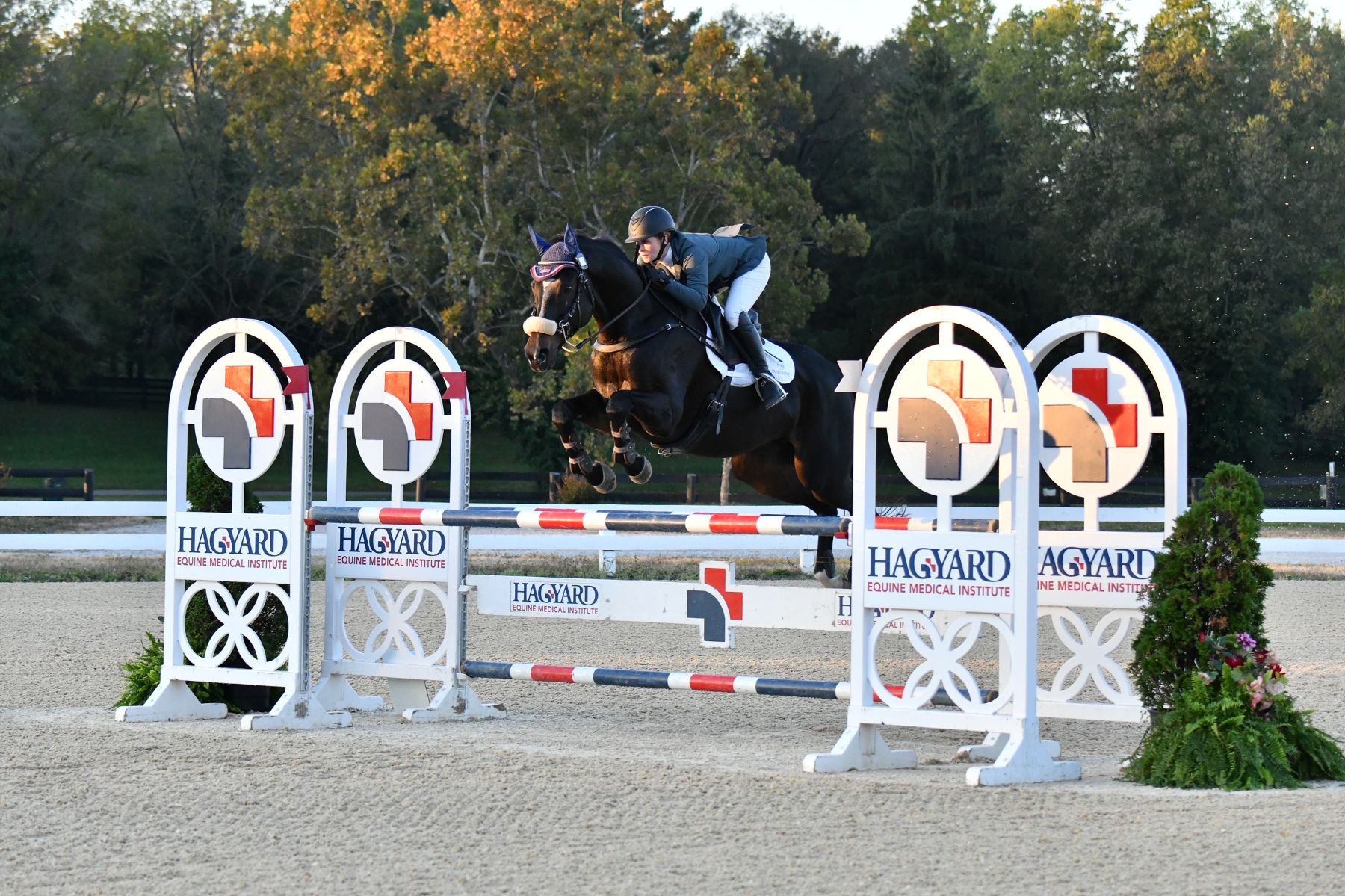
“What’s inspiring is how much they (Thoroughbreds) want to win and how much effort they’ll put into it,” says Rosie Napravnik, shown here competing with the Thoroughbred Army Ranger.
Photo credit: Courtesy Rosie Napravnik
Ask riders why they love off-track Thoroughbreds, and many will say the same thing: They try. Whether working through a challenging exercise on the flat, schooling a tough gymnastic or hacking alone in a new environment, they often approach their work with focus and determination. While many attribute this quality to heart or grit, the explanation is more practical. The psychological traits that define many successful Thoroughbreds, including their work ethic, sensitivity and relationship-oriented personalities, are learned early and reinforced daily on the racetrack.
Experts say genetics, early training and the psychological demands of life on the racetrack shape Thoroughbreds’ tendency to try. How riders communicate with them once their racing careers end continues to shape and reinforce their behaviors. Riders need to understand that psychology matters, because the same traits that make Thoroughbreds responsive and motivated can also make them vulnerable to frustration when people misunderstand.
When riders recognize and channel those traits thoughtfully, they create a foundation for success across disciplines. Misread, they often result in labels such as tense, resistant or “too much horse.”
A Life Built Around Purpose
Before Thoroughbreds begin their second career, they have already lived in a world defined by routine, movement and expectation.
Rosie Napravnik is a retired jockey who, in her career, became one of the most successful female riders in racing history. Since retiring, she has returned to her roots in eventing, the discipline that first drew her to horses. She now relies on her experience riding thousands of racehorses in high-pressure environments while running Off-Track Sporthorses, in Simpsonville, Kentucky, a successful program retraining Thoroughbreds for sport.
That background informs how she understands the Thoroughbred mind. “In the racing environment, there’s always something happening,” Napravnik says. “They’re always going somewhere.” Training schedules, shipping and competition establish a rhythm that leaves little opportunity for stillness. Over time, that rhythm becomes closely tied to how horses regulate stress.
“They need to move,” Napravnik says. “Moving is what releases tension.” On the racetrack, motion is not only a training tool but also a necessity, particularly when a horse feels tense. “That’s the mantra on the racetrack: Move their feet.”
Sensitivity as an Athletic Trait
Elouise Bacon is a PhD candidate at the University of Sydney, in New South Wales, Australia, where she focuses her research on the genetic influences underlying variable drug sensitivity in horses. Her interest in Thoroughbreds grew from competing exclusively on them in eventing.
Her practical perspective has also informed collaborative research, including a 2025 study investigating how racing metrics can predict success in eventing. “Thoroughbreds are ultimately bred to be athletes, and high motivation and perceived sensitivity often come with that territory,” Bacon explains. “Sensitivity allows them to respond quickly to rider cues and navigate challenging courses, but it also means they need careful handling and clear communication to thrive in second careers.”
Napravnik agrees. “I often hear, ‘It’s a Thoroughbred, so it’s tense,’” she says. “No—it’s a Thoroughbred, so it’s sensitive. That means you have to be sensitive, too.”
Thoroughbreds’ Work Ethic and the Will to Try
One of the most striking traits of Thoroughbreds is their persistence, Napravnik says, even when they don’t fully understand the task. “They’re put into a routine from a very young age, and they’re bred to compete,” she explains. “What’s inspiring is how much they want to win and how much effort they’ll put into it. Off the track, that drive becomes a will to try. They want to give their best even when they’re unsure of what you’re asking.”
Bacon emphasizes that both genetics and early training shape this drive. “Selective breeding and structured early experiences amplify both sensitivity and motivation. That combination helps explain why these horses can be highly engaged and responsive in second careers, even when tasks are unfamiliar.”
That same willingness can create challenges when communication breaks down. “If you’re not asking a question in a way they can understand, they’re still trying,” Napravnik says. “It might look like resistance, but it’s really frustration.”
“Recognizing that a horse is trying, not being defiant, allows riders to adjust their approach rather than escalating the problem,” adds Bacon.
For Napravnik, moments of frustration often reflect a missed step in training. “Whenever I’ve had a horse get frustrated, I always feel like I’ve skipped a step or made it too complicated,” she says. “I back up and simplify.” Though resetting can feel counterintuitive in the moment, “everything accelerates once you do,” she adds.
As for temperament, Bacon cautions against viewing it as fixed. “Temperament traits are complex and can vary strongly depending on context,” she says. “While a horse may have a general tendency toward a particular temperament, specific situations can elicit reactions we might not otherwise expect.”
This variability places responsibility on riders to adjust their approach. “Different riders look for different temperamental attributes, just as horses tend to thrive more with certain riders,” Bacon adds.
Teaching Relaxation Without Removing Purpose
Napravnik often uses a Thoroughbred’s very first ride off the track to help them adjust to new experiences while building confidence. “One of my favorite rides is that first hack,” she says. “It’s when you really find out who the horse is. I usually take them out completely alone. If there’s another horse, they’ll just follow (the other horse) because they’re herd animals, and they trust the other horse. But on their own, they have to follow me, think for themselves and make decisions.”
Those first rides often include small, practical challenges. “We have to cross a small bridge or walk through a creek if we want to leave my property,” Napravnik says. “I usually start with the bridge, and on the way home we’ll tackle the creek. That’s usually easier once they’ve already had some success.”
Confidence, Engagement and Adaptability With a Thoroughbred
In Thoroughbreds, work ethic and trust go hand in hand, and their honesty is central to that dynamic. “I’ve had people tell me, ‘This horse isn’t honest,’ but I’ve never really met a dishonest horse,” Napravnik says. “That idea doesn’t hold up; it’s not scientifically true. Horses are incredibly honest; what looks like disobedience is usually confusion or miscommunication. That’s the challenge for us as riders: understanding them, rather than labeling them.”
For Napravnik, perceived problems often reflect, again, unclear communication. “If there’s a problem, there’s a lack of understanding,” she adds.
Despite their structured beginnings, Thoroughbreds often adjust well to new expectations. “I don’t believe a horse’s early background completely defines how they respond to structure and routine later in life,” Bacon explains. “Horses are generally quite adaptable and capable of adjusting to new expectations, environments and routines when given appropriate support and consistency.”
Mental engagement remains critical. “As soon as you give them something to think about,” Napravnik says, “they’re completely with you.”
Applying What We Know About the Thoroughbred Mind
Retraining a Thoroughbred does not require changing who the horse is. It requires adjusting the training environment to match how the horse processes pressure, information and reward. Without that adjustment, their willingness can work against them. “Sometimes they’re so willing and smart that you can move too fast without realizing it,” Napravnik cautions. “Keep it simple and go at the horse’s pace.”
That measured approach also reshapes how riders define success. “Ultimately, success lies in seeing horses genuinely thriving in their second careers,” says Bacon. “It’s important to consider outcomes in the context of each specific horse and to identify what they need both mentally and physically to thrive.”
Napravnik reiterates that “a foundation of clear communication and understanding is everything” when working with a Thoroughbred. “And make sure you have support from people who understand and advocate for Thoroughbreds,” she adds. “Find your tribe!”
Take-Home Message
Thoroughbreds try because they have been shaped to value work, respond quickly to information and remain engaged under pressure. In second careers, thoughtful training ensures those qualities continue to serve them.
__________
Sidebar: The Importance of Turnout
For Rosie Napravnik, former jockey and Thoroughbred advocate and trainer at Off-Track Sporthorses, in Simpsonville, Kentucky, turnout isn’t just a break from routine. It is a chance for a horse to discover who they are. “It’s not necessarily the turnout itself. It’s the socialization,” she explains. “Especially for my very insecure horse, the herd allows them to sort of discover themselves. It shows them spatial awareness, personal space, manners and just how to be a horse.”
She places new horses in an 8-acre field with older, well-socialized horses. At first, newcomers might hang back, unsure of themselves, and might even need to be led over to the herd, but gradually they begin to engage and learn from the herd. “Eventually, they figure it out,” she says. Through these interactions, horses learn lessons in respect, confidence and how to navigate social hierarchies that training alone cannot provide.
Turnout becomes more than exercise or relaxation. Observing horses in the herd helps owners understand their individuality and guide their mental and emotional growth as they train.
SEARCH
Sign up for our education newsletter
trending