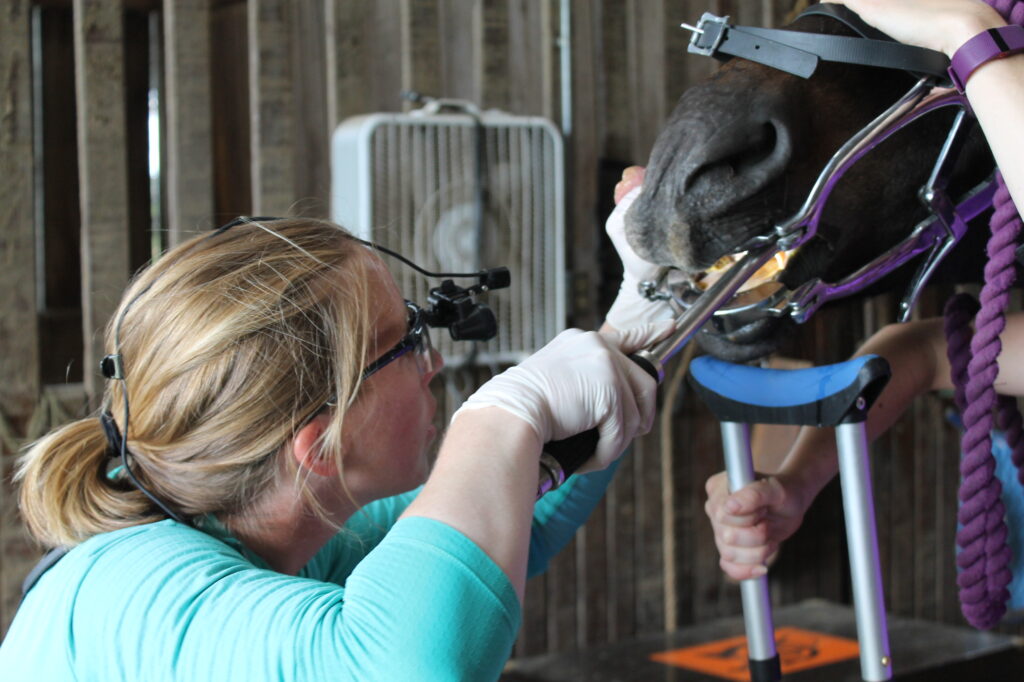
For horses ages 2 to 5, floating every six to nine months can be beneficial to ensure oral comfort. For older horses once a year is typical.
Photo by Stephanie L. Church
Oral health and dentistry are important parts of preventive care for horses of all breeds and disciplines. Thoroughbreds leaving racing careers can have a wide range of dental health histories, from never having had routine oral examinations or floating to frequent maintenance by either veterinarians or lay floaters (nonveterinarian equine dental professionals).
Veterinarians generally consider Thoroughbreds a young population at low risk for the dental diseases seen in older horses. There are, however, many reasons to make sure Thoroughbreds receive routine dental care by an equine veterinarian educated in oral health.
Basic Equine Dental Anatomy
Horses need routine dental exams and care because of their unique dental anatomy and development. Horses’ teeth erupt continuously throughout their lives. As they eat forage, the chewing surfaces of the cheek teeth — premolars and molars — wear down as the jaw moves side to side. Because the horse’s maxilla (upper jaw) is wider than the mandible (lower jaw), this wear is not even across the entire surface of each tooth. Sharp points form on the buccal (cheek) side of the upper arcades of teeth and the lingual (tongue) side of the lower arcades. These sharp points, if left alone, can create painful lesions on the cheeks and tongue. These ulcerations can lead to abnormal chewing patterns, resistance to the bit or contact and other adverse ridden behaviors.
Sharp points can also lead to reduced lateral excursion of the jaw, meaning the horse cannot move his jaws side to side to chew effectively. Removing sharp points during a float, or equilibration, allows freer jaw movement and more effective grinding, improving chewing comfort and feed and forage digestibility.
Aside from sharp points along the buccal and lingual surfaces of the cheek teeth, horses also develop sharp hooks on the front premolars (the “06” teeth, referencing their official number in the horse’s dental chart) and ramps on the last molars (the “11” teeth). These malocclusions can cause abnormal chewing, oral lesions, and discomfort with raising and lowering the head. Retraining involves frequent changes in head position, and oral discomfort can complicate how an OTTB adapts to new exercise. Early attention to dental comfort helps prevent negative associations with new work.
In addition, equine practitioners can identify other, less common problems early on routine dental exams. Fractured teeth, retained caps (deciduous or baby teeth), periodontal (gum) disease and waves or steps caused by conformation or missing or impacted teeth can all be treated or managed with early identification and intervention. Veterinarians can examine incisors for retained caps, conformation faults that might need special attention, such as parrot mouth (overbite), and any missing or malformed teeth. Examining the soft tissues, such as the interdental space where the bit sits, the commissures of the mouth, the soft palate and the tongue with associated tissues, can help identify problems caused by ill-fitting tack, oral masses or even foreign objects trapped in the oral cavity. For instance, many Thoroughbreds train and race with tongue ties, which can cause damage if improperly applied.
Why Thoroughbreds Need Routine Equine Dentistry
Tooth eruption occurs more rapidly in younger horses and slows as horses age. By about age 5, most horses have a fully mature mouth. Young horses’ teeth are a bit softer than in their teenage years, so the grinding action that creates the sharp points can have a more dramatic effect, with sharp points forming within six to nine months between floats. For horses aged 2 to 5, floating every six to nine months can be beneficial to ensure oral comfort, especially in green horses or those learning a new discipline. In older horses, floating once yearly can be sufficient to prevent the formation of oral lesions. The treating veterinarian’s exam findings should guide each horse’s floating schedule.
Young horses often have wolf teeth, officially known as the first premolars, sitting just rostral to (toward front of the mouth) the rest of the cheek teeth. These are usually found in the upper jaw but occasionally in the lower jaw. Do not confuse wolf teeth with canines, which are larger and sit between and just caudal to (toward the tail) the incisors. Male horses primarily have canines, though some mares do develop smaller ones. These teeth evolved for use in fights between stallions. They do not typically cause any issues in young horses unless they become sharp, in which case they can be smoothed down during floating. Wolf teeth, by comparison, are small, with shorter roots, and can cause irritation if the bit contacts them because they can easily become loose. Practitioners can extract wolf teeth easily but should only do so using appropriate sedation and pain management. They should never grind them down with a float, because the remaining root can cause irritation and even become infected.
A full-mouth speculum, bright light and sedation allow the veterinarian to thoroughly visualize the horse’s entire oral cavity and all cheek teeth. Not all equine practitioners perform dentistry or tooth floating, but most general practitioners do provide this service as part of their preventive care or wellness offerings. Equine veterinarians have the training and legal authority to provide intravenous sedation, diagnose oral pathology, and perform procedures such as wolf tooth extractions, which nonveterinarians cannot perform.
Many racetrack practitioners do not have enough time to provide routine dental care to all their backside patients and rely on nonveterinarians to provide floating services on the track, so schedule an oral exam with an equine veterinarian versed in dentistry once Thoroughbreds have landed in their next careers.
Dental pain can impact performance in all horses, but it is especially important to avoid when retraining a horse for a new discipline. This pain can cause negative associations with bit contact, nosebands, and head positions as well as potential problems with chewing and grinding feed, which can lead to weight loss and gastrointestinal discomfort. It is always best to identify rare problems early, when veterinary intervention will most likely have long-term success.
Take-Home Message
In summary, equine dentistry contributes to retraining and overall welfare in equine athletes. Thoroughbreds typically have a lower risk for age-related dental problems but still benefit from routine high-quality maintenance for optimal performance.
Dr. Selvig is an equine general practice and performance horse veterinarian with a special interest in off-track Thoroughbreds. She is a partner at Cleary Lake Veterinary Hospital, in Prior Lake, Minnesota, where she has practiced since 2007.
