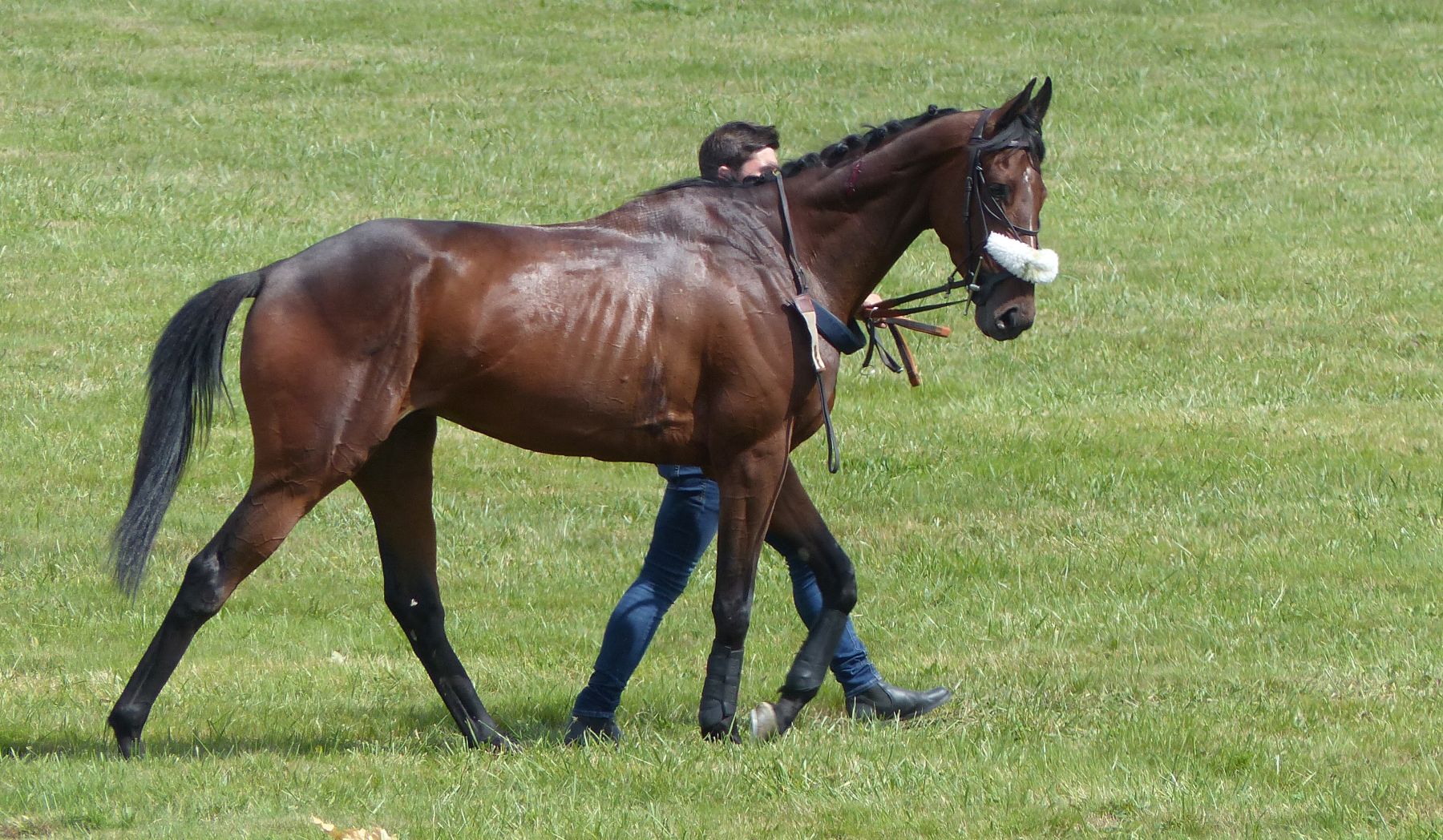
Many racehorses are quite fit and lean which will need to be considered when developing a feeding plan after racing.
Photo credit: Tsaag Valren, CC BY-SA 4.0, via Wikimedia Commons
Many Thoroughbred horses that retire from racing are indeed young and still growing. How to transition from a racing feed program focused on supporting growth and training to one focused on the demands of their next career depends on the individual horse — considering their stage of growth, activity level, current body condition and keeper status.
We turn to a couple of equine nutritionists for their insights into feeding a still-growing OTTB. Amy Parker, MS, PAS, equine nutritionist and technical services specialist at McCauley’s Feeds, in Versailles, Kentucky, and Laurie Lawrence, PhD, professor of equine nutrition in the University of Kentucky’s Department of Animal and Food Sciences, in Lexington, weigh in.
What Does ‘Still Growing’ Mean?
When considering growth in young Thoroughbreds, we generally think of increases in height and weight:
- Bone development or skeletal growth
- The growth plates (areas of cartilage near the ends of the bone) gradually ossify (turn to bone), thus ending bone growth in length (longitudinal growth). Most longitudinal growth, which contributes to horse height, nears completion by 3 years of age.
- Bone growth in width or thickness (appositional growth), with new bone being deposited on the outer surface while older bone gets resorbed from the inner surface, slows in horses at 2 years of age (Stover et al., 1992b).
- Development of muscles, tendons and ligaments
- Muscle mass makes up 96% of a Thoroughbred’s mature weight by 2 years of age.
- Tendon and ligament growth follows bone growth, in that these structures lose the ability to adapt and strengthen once the horse reaches skeletal maturity (approximately 3 to 3.5 years of age).
Thoroughbreds reach approximately 95% of their adult height and 90% of their adult weight by the time they are 2 years old, says Parker. Long bone growth slows to a crawl by 3 years of age, adds Lawrence. In general, long bones are longer than they are wide, have a hollow cylindrical shaft, and serve as the horse’s main levers for movement. These bones include the humerus (located between the shoulder and the elbow), radius and ulna (forearm), and third metacarpal (cannon) of the front limb and the femur (the bone between the pelvis and stifle), tibia and fibula (gaskin), and third metatarsal (again, cannon) of the hind limb.
Lawrence says that although horses reach most of their adult height by 3 years of age, their skeleton continues to change, especially in width. The spinal vertebrae are the last to skeletally mature, where the bones completely ossify and the growth plates close, at approximately 6 years of age for the spinal vertebrae. Lawrence continues by saying these young horses leave the racetrack in a very lean body condition, and if they stay in race training until 6 or 7 years of age, they might take longer to reach a mature frame as they transition into a nonracing career.
Changing an OTTB’s Feeding Schedule
Transitioning from a racing career to a second career can take time — how much time depends on a lot of variables, says Parker.
“Some horses will adapt to nontrack life right away — others not so much,” says Lawrence.
Important considerations include the new living arrangements and feeding schedules. Lawrence says horses at the track eat their first meal quite early in the morning, so if your OTTB lives at a barn that feeds at 7:30 a.m., your horse could be pretty agitated by then. Lawrence gives examples of feeding scenarios of a racing Thoroughbred and one of an OTTB.
Racing Thoroughbred:
- 5:00 – 6:00 a.m. (or possibly earlier) morning small meal
- Hay is often placed in a hay net just inside or outside of the stall; the horse can nibble on it all day
- Groomed and exercised, then put back in the stall
- 10:00 – 11:00 a.m. late morning meal
- 4:00 – 5:00 p.m. afternoon meal
- 8:00 p.m. late evening meal
OTTB:
- Might only get grain meals in the morning and evening, and the horse is turned out soon after feeding
- An OTTB might not have consumed all its feed by turnout time
- If the horse lives in a group feeding situation:
- Young OTTBs are not used to eating in a competitive environment. They might eat slower than their colleagues and get chased away from their feed before finishing.
Lawrence points out that even though most textbooks state that horses will eat 2% of their body weight in hay per day, a more recent study of hay intake at the racetrack suggests Thoroughbreds in training consume about 1% of their body weight in hay per day. This is not surprising because they usually get a fair amount of concentrate, and their body shape includes a very trim abdomen, which could possibly mean the large intestine has a lower-volume capacity than in a nonracing fit horse. Parker and Lawrence agree that from their observations it takes two to six weeks for an OTTB to transition to a typical hay diet.
Nutritional and Feeding Considerations for an OTTB
How you meet the nutrient requirements for the young OTTB depends on their next career and the horse’s individual metabolism. “There is not a clear-cut formula for how any horse should be fed,” says Parker.
Body Condition, Body Weight & Frame Size
Many OTTBs are quite fit and lean and commonly carry a body condition of 4.5 to 5.0 on the Henneke Body Condition Scoring Scale. For many second-career youngsters, there are a few questions you should ask:
- Is the current body condition appropriate for the horse’s second career?
- Will he be going from racing to another high-energy sport or to a lower-energy sport?
- What will the retraining workload be for the OTTB?
- Will the workload be moderate, for example mostly trotting and cantering, easy tasks such as going over ground poles and up and down hills?
- Does the horse need to gain weight and condition?
- What do you envision as mature weight and condition and in what time frame?
- For example, would you be starting at 1,050 pounds and 4.5 body condition score transitioning to 1,150 pounds and 5.5 – 6.0 body condition in 6 months?
- Is the horse a picky eater or hard keeper?
- Obtaining nutritional and feeding management history helps make feed decisions
- What is the horse’s frame size?
- A gangly 3-year-old in the spring differs from an older horse that has not been actively training for a few months
Parker says how quickly a horse can gain weight and achieve the body condition required depends on where he started (thinner takes longer) and the condition in which he was retired from racing.
Age at Racing Retirement
Very young OTTBs, such as 2-year-olds, have slightly higher nutrient requirements than older OTTBs, such as 5-year-olds. Parker recommends a 12% crude protein feed with a high-quality grass hay or a hay containing a small amount of legume (clover or alfalfa) for a 2-year-old.
Lawrence adds that most 14% crude protein feeds are intended for broodmares and growing horses so, in her opinion, a 14% crude protein concentrate would work for horses less than 5 years of age. A slightly higher crude protein level is also good with low or erratic hay quality.
Lawrence and Parker recommend using a commercially manufactured fortified feed because it will provide the minerals and vitamins the horse needs, if provided at the correct feeding rate listed on the label. A 10% crude protein feed can be used if combined with a high-quality grass hay to meet the requirements of the OTTB over the age of 3, says Parker.
Feed Ingredients Matter
“From a feed standpoint, ingredients matter,” says Parker. Researchers have shown that oats provide a very usable form of starch to the horse. This means that an oat-based feed will help improve a horse’s body condition more efficiently and more quickly than a corn- or wheat-middlings-based feed. She adds that a feed with 10% fat will provide more calories per than a feed with 4% fat. For easy keepers, she recommends a lower-fat feed, while elevated fat content can help improve body condition in hard keepers.
“The amount of concentrate (you offer) will be affected by forage quality and quantity — the more forage they consume and the better quality, the less concentrate is needed,” says Lawrence.
She also says pasture works as a good feed — palatable and high in vitamins — but the horses must eat it. Typically, young OTTBs have adapted to stall life on the track and might not have had much pasture time. They might need time to adjust to being turned out.
Parker adds that forage should be fed free choice but select a hay with a lower or higher calorie content to maintain the desired body condition. Some OTTBs can maintain a healthy or heavy body condition on forage alone. In such cases a ration balancer with good-quality forage will suffice. On the other end of the spectrum, for those hard keepers that tend to run leaner, a more calorie-dense diet will be needed. Increasing the amount of hay fed per day (gauge this by weighing the forage) or using a feed with an elevated fat content will help horses gain weight. Alfalfa and clover hay generally contain more calories than grass hays.
Take-Home Message
If you get your OTTB from the track at a young age, he may still have some growing to do, and that should be taken into consideration. In addition, understanding how the horse has been fed could frame some of the decisions you make on choosing feeds and feeding practices. “Work with an equine nutritionist to meet the nutritional needs of the horse and always choose feeds with high quality, easily utilized ingredients and high-quality forages,” adds Parker.