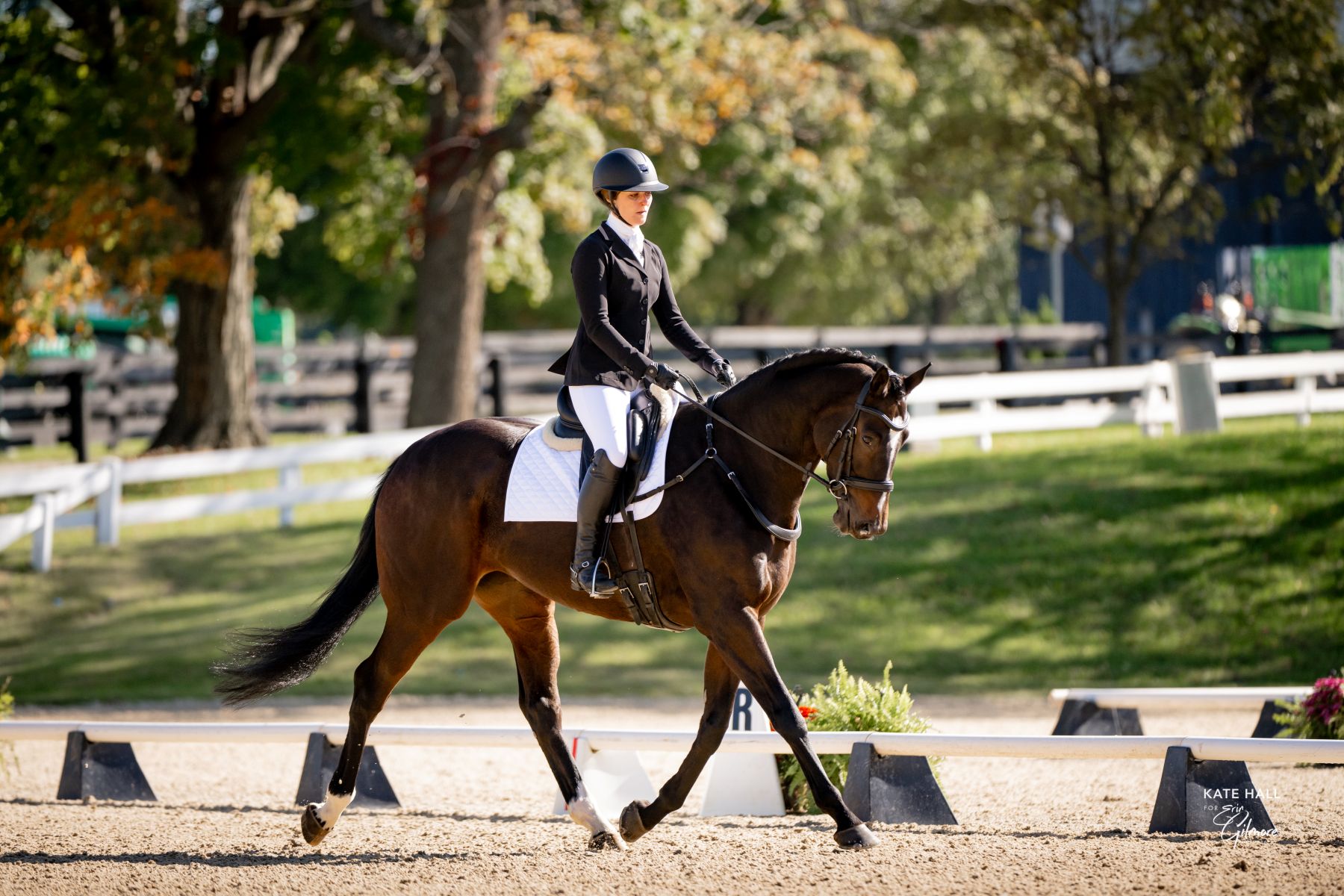
Kelsie Bricker on Perplexing (Tapwrit – Manhatta, by Old Fashioned), a granddaughter of Tapit. Photo by Erin Gilmore Photography
“You can’t ride papers” is a common phrase heard in the equestrian industry, and the subject of bloodlines and pedigree analysis can indeed be a hot topic among off-track Thoroughbred enthusiasts. It’s certainly true that if it were as easy as producing a good pedigree on paper, the breeding of both racehorses and sport horses would be a simple equation, while reality proves there’s much more to producing top quality horses than breeding alone.
Like analyzing conformation, movement or disposition, evaluating the bloodlines of a Thoroughbred prospect for sport or recreation is a tool equestrians can use to help decide if a horse might be a good fit for their program or intended goals. We spoke with two experienced horsewomen for their takes on how they analyze bloodlines to assess Thoroughbreds.
Analyzing the Pedigree
While plenty of horse shoppers or adopters are happy to select prospects based entirely on conformation and movement, those factors are influenced by a horse’s breeding. “The pedigree can help ‘type’ a horse,” says Aubrey Graham of Kivu Sporthorses, in Lansing, New York, a trainer specializing in off-track Thoroughbreds. “It can give you a valuable angle of view and shape what questions to ask. It may be an invitation to look closer or, depending on the goals for the horse, to be more wary. So many factors are related to breeding: movement, temperament, even how a horse might react when it’s stressed.”
When Graham talks about pedigrees and bloodlines, she’s typically looking at the sire, grandsire, dam’s sire, and dam’s grandsire. Because stallions can sire potentially hundreds of foals each year, the statistical sample size is much larger than when looking at mares, making possible trends easier to track. She makes note of sires that pop up in pedigrees of the more rideable, manageable horses she sells, as well as those she’s more likely to find in her personal string, which might be tougher to ride.
“I try to look at grandsires before I start collecting a lot of data on more recent sires,” she says. “The more I learn and more horses I look at, the more I can differentiate what’s a trend from Tale of Ekati, as an example, compared to his son Girvin.”
If Graham is not familiar with a horse’s bloodlines she’ll weigh the movement and conformation more heavily, but she’ll also look for horses of similar breeding to see what traits might be consistent. “This is how I learn how a stallion might stamp his offspring,” she says. Similarly, she can learn what factors might get diluted in the third generation. “Tapit is a great example,” she adds. “His direct offspring are often a particular way, but one generation out that trait might be less consistent.”
Amanda Chance of Breed.Ride.Compete., a pedigree data service and equine business consulting company based in Ocala, Florida, similarly views pedigree as a powerful tool — but prefers to focus on the bottom line of the pedigree, taking a close look at the dam line. “I want to see what else a dam line has produced,” she explains. “Mares, of course, produce way fewer horses than stallions, so this can be more statistically significant. Stallions are interesting, but mares are more so.”
Chance says one of her favorite tools is HorseTelEx, a worldwide pedigree database including all studbooks. Any Thoroughbred in the pedigree of an international sport horse can be found in this database.
She says she likes to use this tool tosearch the names on the tail female line of a pedigree to see if any of the mares in the dam family have produced offspring for sport. “Sometimes I’ll find Thoroughbred mares, who weren’t great race mares, who have produced, say, a Grand Prix dressage horse and a 1.40m show jumper,” she adds. “It’s always interesting to discover these mares who found their way into sport horse breeding.”
Chance admits it can be more difficult to follow dam lines when looking at Thoroughbred pedigrees for sport due to sample size. She’s noticed when she’s analyzing a pedigree and goes back to the original dam families, some mares show up more frequently than others.
“I don’t have enough data yet to make a conclusion,” she says. “I just know that some of these families come up again and again in show jumping and eventing.”
Interpreting Bloodlines
Log on to your favorite social media platform and head to where Thoroughbred sport horse enthusiasts discuss pedigrees, and you’ll notice some familiar names coming up again and again: breed-shaping stallions whose descendants number in the thousands. You’ll also find polarizing opinions about some of these stallions—that all A.P. Indys make good jumpers, or Storm Cats are known for being difficult. How significant are these old greats in today’s breeding?
“Those stallions are certainly influential in the third generation,” says Chance. “Not as much if they’re sixth generation or off the page completely. The sample size is so big now for those stallions. People tend to just repeat what they’ve heard because we don’t have enough information about how these horses perform in sport.”
“Storm Cat is such a great example,” agrees Graham. “You really can’t lump big name breeding the way people tend to do anecdotally. We’re usually so far removed now in the pedigree from a stallion like Storm Cat that it doesn’t work to make generalizations like, ‘Oh all Storm Cats are difficult or fractious.’ A few generations out, I have found the opposite to often be more accurate of their ride.”
That said, Chance says she has found data-based evidence that does speak to the athletic influence of some of these older greats. She references research she did into the prevalence of A.P. Indy in the pedigrees of upper-level eventers: “The breeding numbers of these stallions were similar, but when you look at the upper levels you find very little Storm Cat breeding and lots of A.P. Indy. The question is, why is that? The data is only half of the story.”
It’s in that other half where interpretation and experience become key. With no breed organization for the Thoroughbred as a sport horse to keep relevant data (The Jockey Club’s purview is specific to Thoroughbred breeding for racing), equestrians must rely on anecdotal evidence, often crowd-sourcing opinions on pedigrees based on the experiences of others.
It’s a tricky world to navigate. Due to the nature of Thoroughbred racing, stallions’ commercial popularity tends to be established within a few years of their retirement. By comparison, the development of sport horses to the upper levels in numbers that could be statistically relevant for collecting data takes far longer. It is already a few years behind the Thoroughbred industry by nature of working with horses after their retirement from racing. “It takes a while for a pool to hit the sport horse market,” Chance explains. “By the time we know anything about what these stallions are producing for sport, we’re years beyond that in the breeding industry.” It’s then up to individuals to anecdotally find connections between sires and disciplines.
For now, professional resellers such as Graham and pedigree gurus like Chance have plenty of combined wisdom to help guide the next generation of Thoroughbred fans to good matches. After all, one can’t ride papers, but they can certainly use them as a map.
“There’s no such thing as a bad pedigree,” Graham says. “A horse I may not find interesting on paper might be exactly the horse sought after by another rider.”
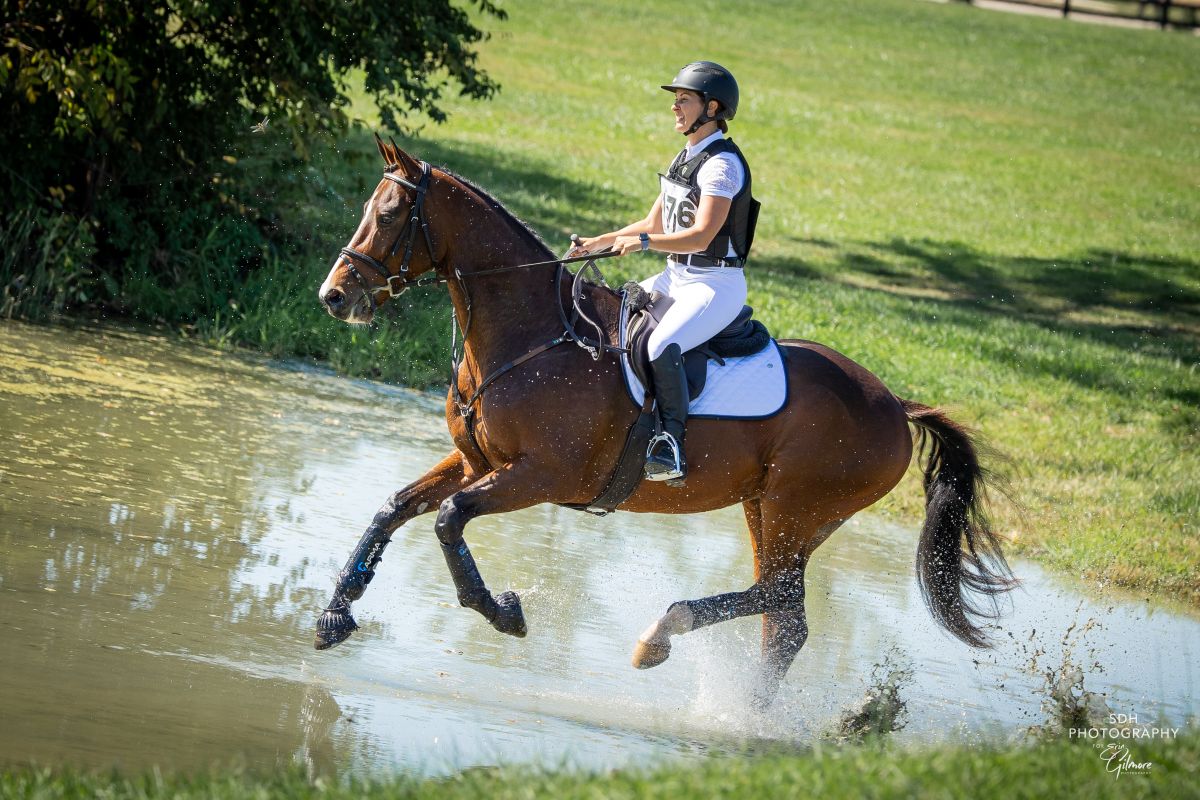
Code Violation (Honor Code – American Diva, by Quiet American), seen here with Jamie Hernandez, is a grandson of A.P. Indy. Photo by Erin Gilmore Photography
Bloodline Data from the Thoroughbred Makeover
The Retired Racehorse Project has what might be the most robust collection of data on horses in their first year of retraining for careers beyond racing, compiled through horse registration and final entry for the annual Thoroughbred Makeover. Here are a few interesting data points on the breeding of Makeover horses over the past 10 years of event data:
- Bernardini has sired the most Makeover-registered offspring, with 29 horses since 2015. Freud and Malibu Moon are close behind, each siring 26.
- Freud and Malibu Moon have each been represented by at least one offspring annually at the Thoroughbred Makeover since 2015.
- Five mares have each been represented by three offspring at the Thoroughbred Makeover over the past decade: Ashley’s Folly, Livermore Valley, Mariastheboss, Merry Princess and Rose of Lee. Mariastheboss herself competed in the Former Broodmare division.
- Within the Competitive Trail division, the Candy Ride (ARG) sire line is represented by 12 offspring total—the most descendants in a single discipline from multiple generations of a sire line over the past decade.
- Show Me the Carats might be the most successful dam of Makeover horses in the event’s 10-year history, having produced 2020 Dressage winner and Freestyle fourth place Elbow Room, as well as 2022 Freestyle fourth place and Dressage 11th place Evaluator.
Tools for Looking at Breeding
Want to research your own Thoroughbred’s pedigree? Here are industry tools for taking a deeper dive:
- Equibase: free Thoroughbred database including basic second-generation breeding, as well as race record and auction history
- Equineline: free five-generation pedigree for registered Thoroughbreds
- HorseTelEx: worldwide sport horse database that includes any Thoroughbred appearing in sport pedigrees, along with the performance records of their offspring