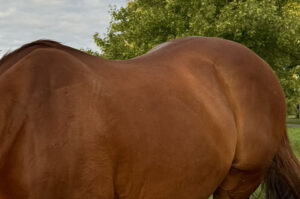
Dysfunction or injury of the sacroiliac (SI) region can occur in two main areas: inflammation of the dorsal SI ligaments and arthritis of the SI joint itself. Photo courtesy Stephanie L. Church
Sacroiliac (SI) region pain can cause back discomfort, lameness and poor performance in horses. The SI joint lies at the junction of the pelvis and the spine, between the wing of the ilium and wing of the sacrum. Unlike many other joints, it allows only limited gliding motion and contains minimal synovial fluid, with two distinct types of cartilage. Its deep anatomic location and the vague clinical signs horses show with pathology (disease or damage) make SI problems difficult to diagnose and manage.
Types of Sacroiliac Dysfunction
Dysfunction or injury of the SI region can occur in two main areas: desmitis (inflammation) of the dorsal SI ligaments and arthritis of the SI joint itself. Riders often first notice SI-region pain in horses under saddle. Signs include general hind-limb stiffness, poor engagement, reduced desire to go forward, deteriorating quality of the canter or frequent swapping of leads behind, refusing fences and behavioral issues such as bucking or rearing when asked to go forward.
Symptoms can begin acutely, such as with trauma to the hindquarters after a slip, fall or trailer incident, but more commonly they begin mildly and gradually increase in severity. For example, a rider might notice the canter feels weak or unbalanced and the horse struggles to push off at fences. That could progress to struggling or refusing to go forward when asked and bucking and/or rearing.
Sports medicine specialist Rob van Wessum, DVM, MS, Dipl. ACVSMR (EQ), Cert Pract KNMvD (Equine), sees a substantial number of performance horses with SI pain, including many Thoroughbreds, at his practice, Equine All-Sports Medicine Center, in Mason, Michigan. He says his clients who ride Thoroughbreds primarily use them for eventing, and he often sees them two to three years after retiring from racing and starting their new careers. He says racehorses train primarily at the canter from a young age. Because the SI ligaments exhibit their greatest range of motion at that gait, they can overstretch and develop fibrosis. Fibrotic tissue lacks the elasticity of healthy ligamentous tissue and, as a result, sustains injury more easily under stress. Many horses can compensate for this in their new careers until they reach higher levels such as upper-level dressage or eventing.
Diagnosis of SI Dysfunction in Thoroughbreds
Again, sacroiliac region dysfunction can be difficult to definitively diagnose, but van Wessum has identified six distinct exam findings that can help veterinarians identify it. When a horse exhibits three or more indicators on the checklist, findings suggest the SI region as the likely source of pain.
- Tracking narrow behind: When the horse walks or trots, he places the hind feet close together, even appearing as if tracking along a tightrope.
- Lateral walk: When the horse exhibits more of a “pacing” pattern in the walk, most easily identified when walking a serpentine pattern.
- Haunches in or out: When the horse carries himself in a slight bend due to sacral asymmetry, creating a haunches-in or out track instead of a straight track.
- Asymmetric tail position: When the horse holds the tail to one side, and it stays there even on a serpentine track.
- Bunny-hop canter: When the clear three-beat canter becomes less obvious or disappears, and the hind feet land very close together or at the same moment, creating the appearance of a bunny hop even during a relaxed canter.
- Reduced flexibility of the lumbosacral region: When the horse shows asymmetrical lateral (side-to-side) and ventral (upward-and-downward) flexion of the lumbosacral region, as identified with a hands-on veterinary exam.
To diagnose SI pain, van Wessum recommends a thorough physical exam, along with neurologic and lameness evaluations that include watching specifically for the six common clinical signs he identified.
Once a veterinarian suspects a horse has SI pain, imaging options remain limited because the joint’s depth. Most radiograph (X ray) units lack the power to capture diagnostic images of the region. Computed tomography (CT) systems capable of imaging the hindquarters are not widely available and, even when they reveal any asymmetry or joint pathology, those findings might not explain the horse’s pain. Nuclear scintigraphy (bone scan) might or might not show increased uptake (indicating remodeling activity) in the SI region, but researchers have shown that those findings don’t reliably match whether the horse is actually painful there. Ultrasound of the ligaments and joints can be most useful but requires a high degree of skill by the ultrasonographer and cooperation by the patient, because the practitioner must complete some of the evaluation transrectally. Specialists sometimes use techniques for infiltrating a local anesthetic agent into the SI region to confirm SI pain, but those blocks carry higher risks — such as the horse becoming recumbent (i.e., lying down) temporarily — than routine regional nerve blocks used in limbs.
Treatment and Rehabilitation of a Horse with SI Dysfunction
Even without diagnostic blocks or ultrasound confirmation, veterinarians can make a presumptive diagnosis of SI pain based on the horse’s clinical history and physical exam and initiate treatment. If a lot of inflammation is present, a long course of lose-dose anti-inflammatory medications — usually phenylbutazone (Bute) or firocoxib — can be very helpful, along with daily icing of the affected area after exercise. Corticosteroid injections in the region of the joints can help reduce local inflammation, but they will not help if the problem originates in the dorsal sacral ligament. van Wessum stressed that the most important piece of treatment and recovery for SI dysfunction in horses is a slow, correct rehabilitation plan.
For both ligament injury and joint arthritis, the rehabilitation program must focus on lumbar spine rotation (lateral motion) in conjunction with pelvic ventroflexion. To achieve this, riders work horses on circles of changing diameters, from 65 feet or more to 15 feet or less, with frequent direction changes. First ride these exercises at the walk, then add trot and canter in at later stages, ultimately progressing to a lower-level dressage-based workload that includes a lot of spiral-in and spiral-out circles as well as other lateral work.
Sacroiliac joint arthritis can improve substantially with a rehabilitation program of just a few weeks; for serious ligament injury, it could take four to six months before fully returning to function. van Wessum says he believes soft tissue injury contributes more to SI pain than arthritis in most cases.
Other Considerations for Thoroughbreds With SI Pain
Practitioners have used many adjunct and complementary therapies to relieve pain in cases of SI dysfunction, including chiropractic, acupuncture, and pulsed electromagnetic field therapy (PEMF devices). Evidence indicates these treatments can help with general back pain, but researchers have not demonstrated a specific benefit for SI dysfunction.
Adjunct treatments will not resolve a true SI problem on their own. Use them only in conjunction with a tailored treatment and rehabilitation plan developed in cooperation with the veterinarian and other care team members, such as bodyworkers, farriers, and nonveterinarian chiropractors. van Wessum often involves the horse’s trainer or instructor to help the rider execute the ridden exercises effectively and help gauge progress.
Veterinarians cannot always predict early on if a Thoroughbred will have SI pain. No clear correlation exists between when a racehorse started his racing career or how many starts he had and developing SI dysfunction. The best prevention is slow and steady training, making sure to develop adequate strength and conditioning for each new skill or level. Prepurchase exams on Thoroughbreds are always recommended prior to purchase, and van Wessum recommends screening for SI dysfunction at that time and performing an ultrasound, if possible, if any abnormalities are identified.
Take-Home Message
Veterinarians should consider sacroiliac pain and dysfunction when Thoroughbreds exhibit vague signs of pain in the hind end, slow onset of decreased performance or behavioral issues or deterioration of the canter quality — especially with increased work. These horses should be evaluated by a practitioner experienced in sports medicine who can help develop and monitor an appropriate course of treatment and rehabilitation.